Grant Lifecycle Stages Explained: All 8 Stages, Start to Finish
The grant lifecycle explained stage by stage, from finding a funder through closeout, with the deliverable, the owner, and the checkpoints for each stage.
Last updated: September 2026
A report goes in late. Money gets spent against the wrong budget line. A renewal deadline passes while the team is still assembling the final report for the award it would have replaced. None of those are writing problems. They are timing problems, and the grant lifecycle is the sequence built to prevent them. It maps every piece of work attached to a single award, from spotting the opportunity to deciding whether to go back for more.
This guide walks all eight stages in order, gives the deliverable and owner for each, and covers what changes by funder type.
Quick Answer: What Are the Stages of the Grant Lifecycle?
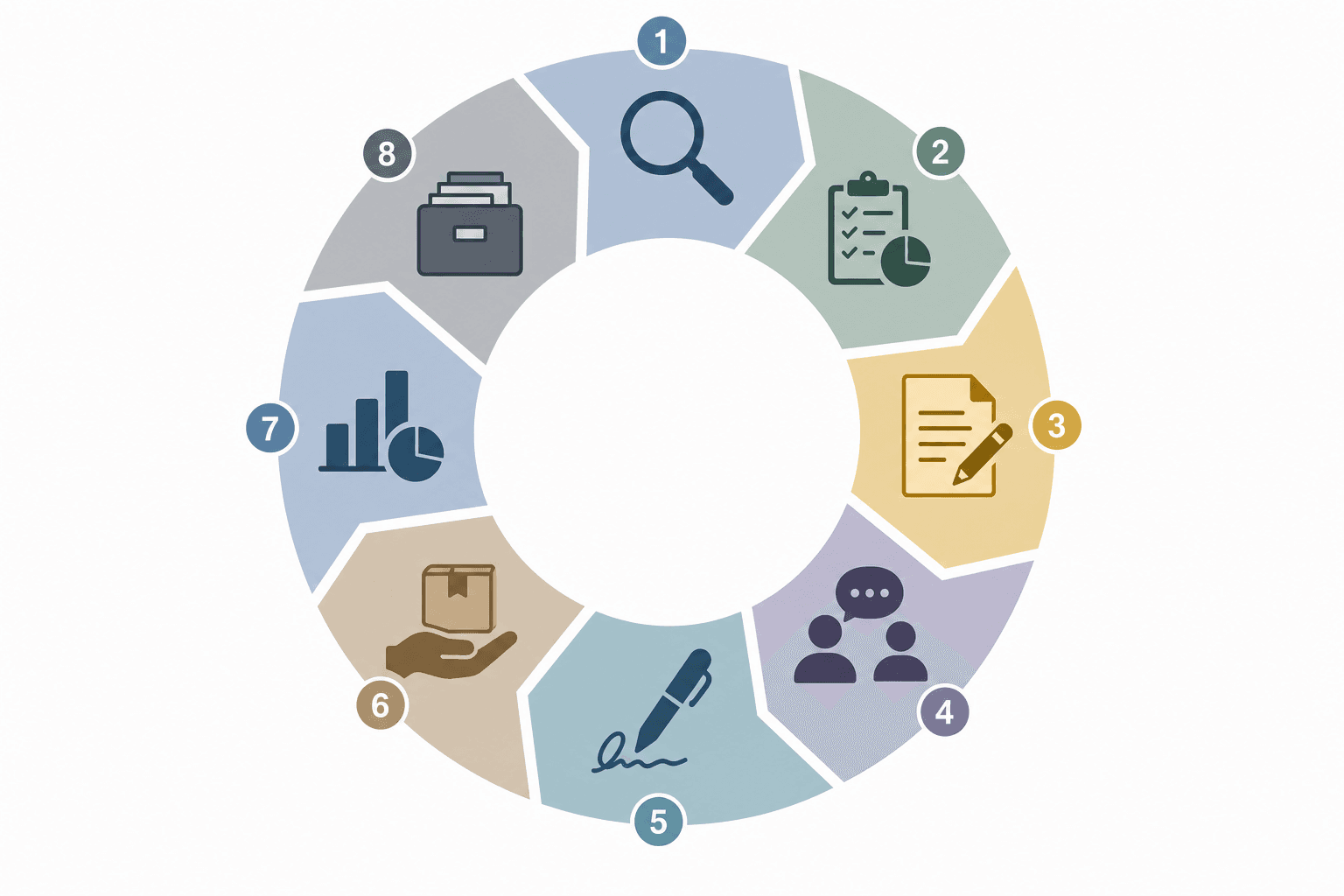
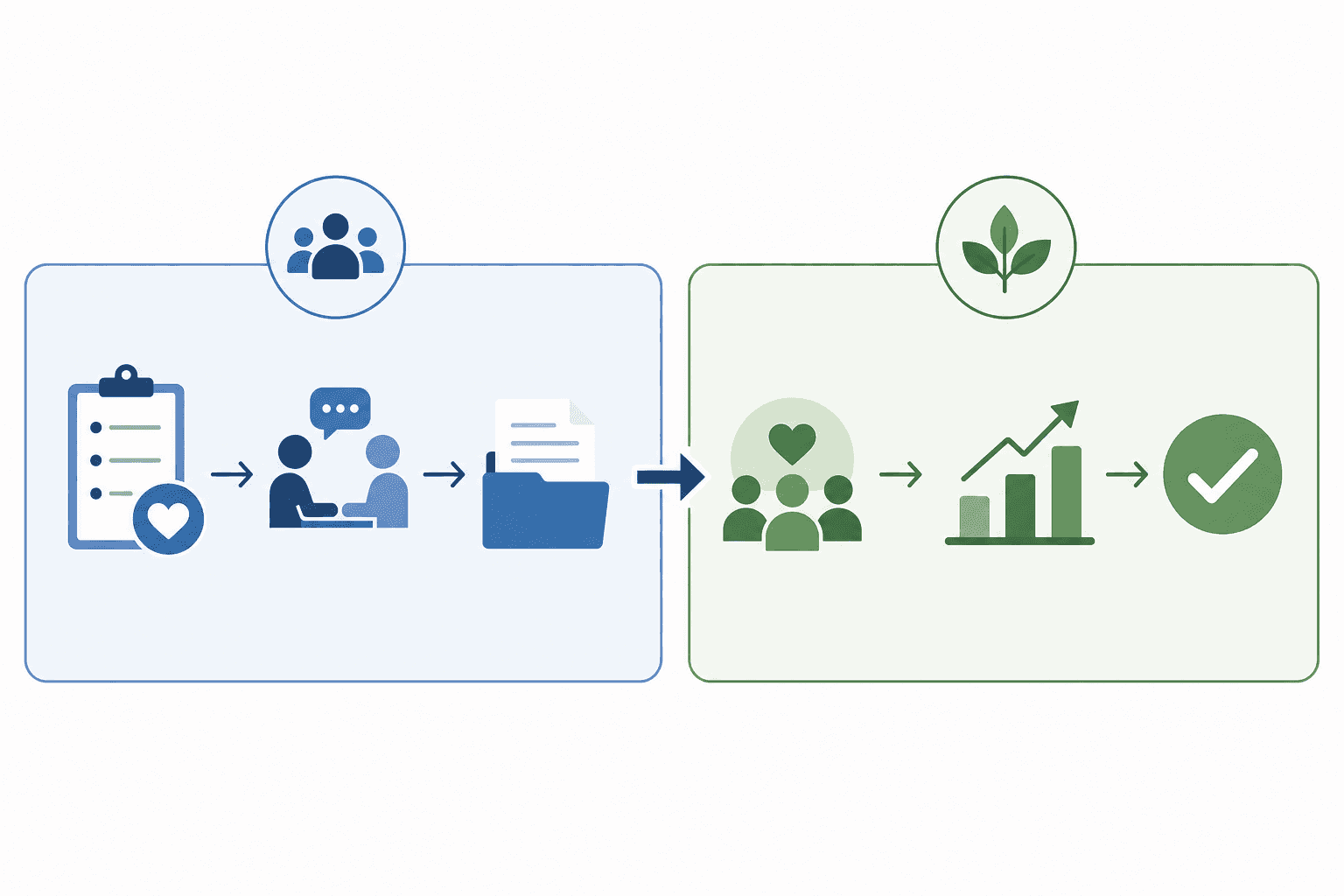
The grant lifecycle has eight stages: identify opportunities, plan the project, write and submit the application, funder review, award setup, implementation, reporting, and closeout with a renewal decision. Stages one through four happen before any money moves. Stages five through eight happen after the award letter arrives. Every stage has a deliverable and an owner.
Free download: Grant lifecycle checklist as Word .docx. No email address required.
What Is the Grant Lifecycle?
The grant lifecycle is the full sequence of work attached to a single grant, running from identification of a funding opportunity through final closeout. Teams often split it into two jobs, grant writing and grant management, and staff them separately. The work itself does not divide that cleanly.
The lifecycle splits into a pre-award half and a post-award half. Pre-award covers finding opportunities, deciding which to pursue, and getting an application in. Post-award covers accepting the terms, spending against the approved budget, reporting on results, and closing the file. The handoff between the halves is where information goes missing, because the person who wrote the promises is often not the person who delivers them.
Calling it a cycle rather than a pipeline is deliberate. Closeout is not an ending. The final report, the outcome data, and the funder relationship all become inputs to the next application. The grants lifecycle management guide looks at the operating model behind these stages.
The Grant Lifecycle Stages, Start to Finish
The grant lifecycle stages are identify, plan, write and submit, funder review, award setup, implementation, reporting, and closeout. Each stage produces a specific deliverable and has a default owner on a typical grant team.
| Stage | What happens | Main deliverable | Usual owner |
|---|---|---|---|
| 1. Identify | Find and qualify opportunities that fit the mission and eligibility rules | Shortlist of eligible opportunities | Development lead |
| 2. Plan | Scope the project, build the budget, make the go or no-go call | Go / no-go decision and draft budget | Program and finance |
| 3. Write and submit | Draft the narrative, assemble attachments, submit in the funder's system | Submitted application and confirmation receipt | Grant writer |
| 4. Funder review | The funder screens, scores, may ask questions, then decides | Award notice or declination | Funder |
| 5. Award setup | Accept the terms, open the account code, load every required date | Signed agreement and populated calendar | Finance and grants manager |
| 6. Implementation | Run the funded work, track spending against the approved budget | Activity records and expense documentation | Program manager |
| 7. Reporting | File interim, annual, and financial reports on the funder's schedule | Reports submitted and accepted | Grants manager |
| 8. Closeout and renewal | Final report, reconcile, archive, decide whether to reapply | Closeout package and renewal decision | Grants manager |
Stage 1: Identify and Qualify the Opportunity
Stage one ends when you have a shortlist of opportunities you are actually eligible for. The work is filtering, not collecting.
Three filters do most of it: eligibility, geography, and funding range. Read the eligibility section before anything else. Check the applicant type, the service area, whether a fiscal sponsor is required, and whether the award size matches the project you can staff.
Where you look depends on funder type. Federal opportunities post on Grants.gov and on the awarding agency's own system, while state and local agencies each run separate portals. Private foundation giving history is public through IRS Form 990-PF. Part XIV of that return lists each grant paid during the year with the recipient's name, the purpose, and the amount, and where a foundation accepts unsolicited requests it also gives the application address, the required format, and any submission deadlines (IRS, Form 990-PF, 2025). Past grants are a better eligibility signal than a mission statement.
Stage 2: Plan the Project and Make the Go or No-Go Call
Stage two ends with a written decision to apply or not, plus a budget a finance lead has seen. This is the cheapest place to say no.
The go or no-go call is easy to skip when a deadline is close and someone senior likes the idea. Answer these before drafting: do we meet every eligibility requirement, can we staff the work if we win, does the budget cover true cost including the overhead the funder allows, is there a match requirement we can document, and what happens to the program when the award ends?
Build the budget before the narrative. A budget written afterward gets reverse-engineered to hit a number, and reviewers notice. Working from a structured grant proposal budget template forces the cost categories into the open while there is still time to change the scope rather than the arithmetic.
Stage 3: Write and Submit the Application
Stage three ends with a submission confirmation from the funder's system, saved somewhere other than one person's inbox.
Drafting follows the funder's structure. Answer the questions in the order asked, use their headings, respect their word limits. Reviewers score against a rubric, so read the review criteria first and put the effort where the points are. Assembling the full document section by section is covered in how to write a grant proposal.
Submission is a separate risk from the writing. Portals reject files for format, size, and naming reasons, and a portal clock runs on whatever time zone the funder states. Register in the funder's system well ahead of the deadline. Federal applicants clear two registrations before they can submit anything, and Grants.gov advises that the SAM.gov entity registration averages 7 to 10 business days to process once the information has been entered (Grants.gov, Organization Registration).
Stage 4: Funder Review and Decision
Stage four belongs to the funder. The applicant's job is to answer clarification requests quickly.
Review usually runs in passes: an administrative screen for eligibility and completeness, scoring against published criteria, then a funding decision constrained by the money available. An application can score well and still be declined because the program ran out of funds.
Use the wait to prepare award setup work: the account code, the reporting calendar, the data collection sheet. If the answer is no, ask for reviewer comments. They are the clearest account you will get of why an application failed.
Stage 5: Award Setup and Acceptance
Stage five ends when the agreement is signed and every date the funder imposed sits on a shared calendar.
Read the award terms as a document separate from the proposal. A funder may award less than requested, restrict a budget line, or add a condition that was not in the notice. Compare the awarded budget to the requested budget line by line before anyone spends anything.
Then load the calendar: interim and financial report dates, the period of performance start and end, any prior-approval thresholds for budget changes, and the date you have to decide about renewal.
Stage 6: Implementation and Compliance
Stage six is where the funded work happens and where the paper trail is either built or lost. Compliance is a recording habit, not an audit event.
Three habits run continuously through this stage. Spending is coded to the grant and reconciled against the approved budget every month. Program activity is documented as it happens, with dates and counts. Any change that needs funder approval, such as a budget shift or a change in scope, goes in writing before the change is made.
Federal awards add a defined rulebook. The Uniform Guidance at 2 CFR Part 200 sets uniform administrative requirements, cost principles, and audit requirements for federal awards, and your own award terms say which parts apply to you.

Stage 7: Reporting
Stage seven ends when the funder accepts each report, not when you submit it. Reporting is where the promises made in stage three get measured.
Reports usually come in pairs: a narrative on program progress and a financial report on spending. The two have to agree. A narrative claiming far more people served than the expense records support raises a question the funder will ask, and it is a hard one to answer after the fact.
The work that makes reporting easy happens earlier. If the evaluation plan named the measures and the collection method back in stage two, the report is transcription. If it did not, it becomes a research project against records never designed to answer the question. Writing a specific grant proposal evaluation plan at proposal stage buys that time back.
Stage 8: Closeout and the Renewal Decision
Stage eight ends with a complete archived file and a documented decision about whether to reapply.
Closeout covers the final program report, the final financial report, reconciliation of unspent funds, required attachments, and record retention. For federal awards, 2 CFR 200.334 requires recipients to keep award records for three years from the date they submit the final financial report, and to hold them longer if litigation, a claim, or an audit finding is still open. Other funders set their own period in the agreement. Confirm in writing that the funder considers the award closed, and save that confirmation with the file. A stage-by-stage grant closeout checklist covers the sequence in detail.
The renewal decision is the part that gets skipped. Before the file closes, answer three questions in writing: did the program do what the proposal promised, what did it actually cost against budget, and would we apply again with changes? Those answers become the strongest evidence in the next application.
What Grant Lifecycle Management Actually Involves
Grant lifecycle management is the practice of running all eight stages in one system so work does not fall between them. It rests on one record per grant, one named owner per stage, and one calendar carrying every date the funder imposed.
One record per grant means the notice, the submitted application, the award terms, the approved budget, the reports, and the correspondence live in one place. Scattered records are why teams answer funder questions from memory.
One named owner per stage makes the handoffs explicit. The riskiest is stage three to stage five, when the application leaves the writer and the delivery obligations land on program staff who may never have read the narrative. A walkthrough of the awarded proposal with the delivery team in week one closes that gap while it is still cheap to close.
One calendar means every funder-imposed date is visible to more than one person, entered at award setup rather than when it gets close.
How the Grant Management Process Changes by Funder Type
The grant management process keeps the same eight stages regardless of funder, but the paperwork, the systems, and the review timelines change from one funder type to the next.
| Funder type | Where the opportunity appears | Rulebook for the award | What catches applicants out |
|---|---|---|---|
| Federal | Grants.gov and the awarding agency's own system | Uniform Guidance at 2 CFR Part 200, plus the award terms | Entity registration must be active before you can submit |
| State and local | Each agency runs its own portal, with its own login and formats | State statute plus the grant agreement | No single search covers every state portal |
| Private foundation | The foundation's site, a published RFP, or an invitation | The award letter and grant agreement | A published deadline may be for a letter of inquiry |
| Corporate | Company giving pages and local requests for proposals | The agreement and any sponsorship terms | Timing can follow the company's budget calendar, not a published cycle |
A team working across funder types is therefore running several versions of stages one, three, and seven at once, on unrelated calendars.
Where the Grants Process Breaks Down Most Often
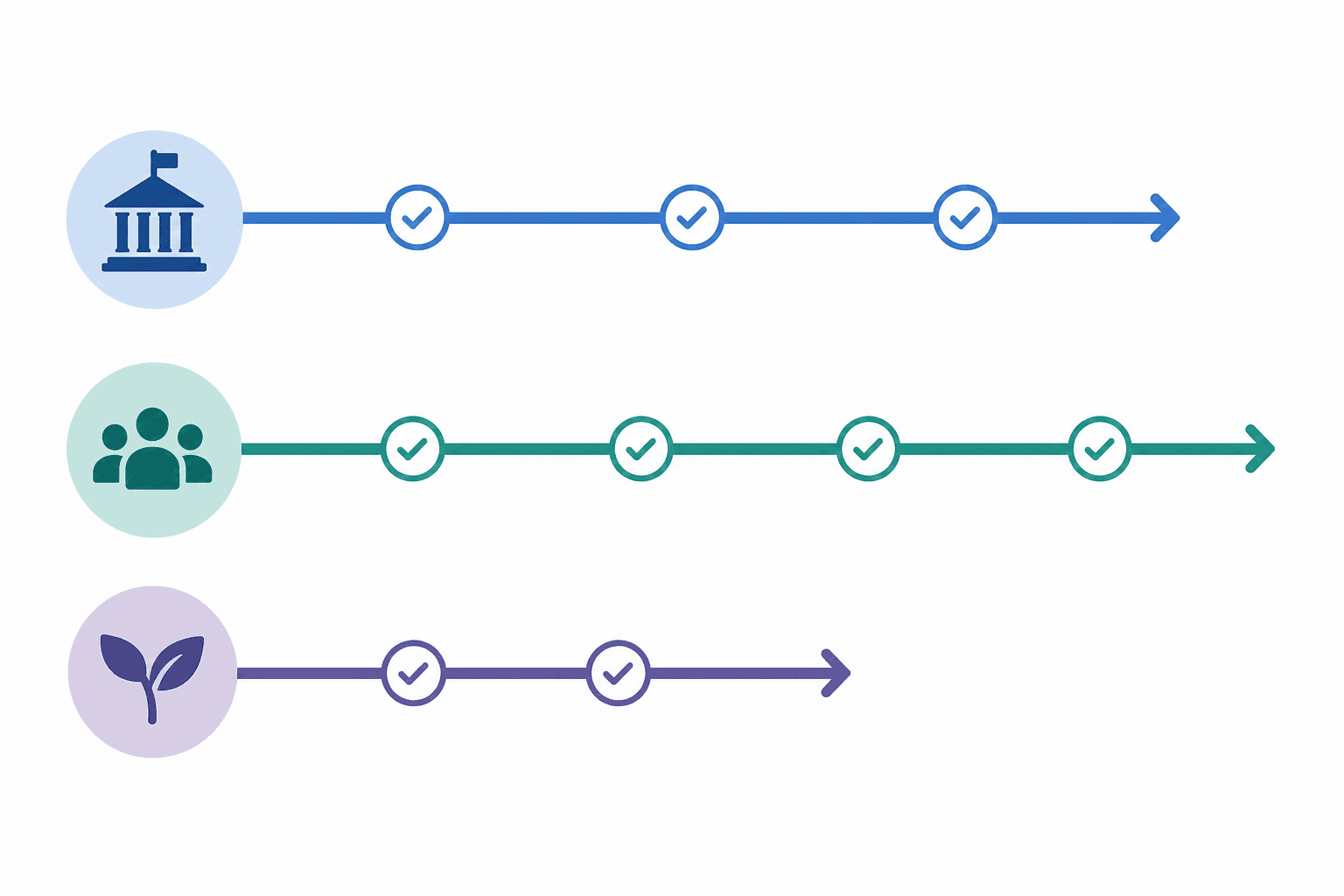
The grants process fails at the seams between stages far more often than inside them. Five of those seams are worth naming, because each one has a cheap fix.
| Where it breaks | What it looks like | The fix |
|---|---|---|
| The pre-award to post-award handoff | The writer knows the commitments; the staff delivering the work never read the narrative | Walk the awarded proposal through with the delivery team in week one |
| Dates held in one person's head | A report deadline surfaces the week it is due, or after | Load every funder date into a shared calendar during award setup |
| Budget drift | Spending does not match the approved budget categories | Reconcile against the approved budget monthly, not at closeout |
| Evidence gathered at the end | The report asks for a number nobody was tracking | Build the tracking sheet when you write the evaluation plan |
| No renewal trigger | The renewal deadline passes while closeout is still in progress | Set the renewal decision date at award setup |
Four of the five share a root cause: work that belongs at the start of the lifecycle gets deferred to the end, where it costs more. The lifecycle management guide covers the cadence that keeps those seams closed.
Subsidy Lifecycle Management: The Same Cycle From the Funder's Side
Subsidy lifecycle management describes the same sequence viewed from the awarding side rather than the applying side. The agency or foundation distributing the money runs its own cycle: publish the notice, screen applications, score, award, monitor, close.
The two cycles are locked together. Every date on an applicant's calendar is an output of the funder's process. Their review window sets when you learn the outcome, their reporting schedule sets your stage seven, and their fiscal year sets when new opportunities appear.
The funder's own cycle also tells you what gets watched during stage six. Awarding bodies monitor for the same few things: is the money going where it was approved to go, is the work on the promised timeline, and are the reports arriving complete and on time. Those questions are most of what grant compliance means from the funder's chair.
FAQ
What is grant lifecycle management?
Grant lifecycle management is the practice of tracking one grant across all eight stages in a single system rather than in a different tool for each stage. It solves one problem: information created early, such as what the proposal promised or which measures the evaluation plan named, is needed later by a different person. One record per grant, a named owner per stage, and one shared deadline calendar are what make that transfer work.
What is the grant lifecycle?
The grant lifecycle is the full sequence of work attached to a single grant, from identifying the opportunity through closeout and the renewal decision. Four stages sit before the funding decision and four sit after it. The word cycle carries weight: the final report and the outcome data from one award become the evidence base for the next application, so stage eight feeds stage one.
What are the stages of a grant?
The stages of a grant are identify, plan, write and submit, funder review, award setup, implementation, reporting, and closeout. Stages one through four are pre-award and produce an application. Stages five through eight are post-award and produce spending records, reports, and a closed file. Closeout feeds the next application, which is why the sequence is called a cycle.
What is grant compliance?
Grant compliance means meeting the conditions attached to an award: spending only on approved budget lines and allowable costs, delivering the work described in the funded proposal, getting written approval before a material change, and filing every required report on the funder's schedule. For federal awards the baseline rules sit in the Uniform Guidance at 2 CFR Part 200, and the award terms name which parts apply.
How long does the grant lifecycle take?
The funder sets the timeline, not the applicant. The notice of funding opportunity states the submission deadline, and the award terms state the period of performance and the reporting schedule. Federal timelines also have a fixed floor before you can apply at all: Grants.gov advises that SAM.gov entity registration averages 7 to 10 business days to process. Read those dates first and build your internal deadlines backward from them.
Who is responsible for managing the grant lifecycle?
Ownership shifts by stage. Development leads usually own identification, program and finance staff own planning and the budget, a grant writer owns drafting and submission, and a grants manager owns award setup, reporting, and closeout. Small organizations often have one person covering several roles, which makes writing down the owner for each stage more important, not less.
Where to Start
Pick one active grant and map it against the eight stages. Write down which stage it is in, who owns that stage, the next funder-imposed date, and whether that date exists anywhere other than one person's memory.
The usual bottleneck after that is stage one: finding opportunities you are eligible for without spending a day a week on portal searching. GrantCue tracks opportunities across federal and state portals in one search, with deadline tracking, tasks, and reporting for the stages that follow. You can search current grant opportunities and see what matches.