Funder Fit Check Before Applying
A funder fit check before applying screens geography, program area, grant size, eligibility and access from public filings so you apply only where the record shows alignment.

In this article (10)
- Quick Answer: What Is a Funder Fit Check Before Applying?
- How to Run a Funder Fit Check Before Applying
- Geography Fit: Where the Funder Actually Gives
- Program Area Fit: What the Funder Counts as In Scope
- Grant Size Fit: Whether Your Ask Matches Past Awards
- Stage and Eligibility Fit: Who the Funder Will Fund
- Relationship and Access Fit: Whether You Can Get in the Door
- Put the Five Screens Into a Go Decision
- FAQ
- File the Sheet and Apply Only Where the Record Aligns
A funder fit check before applying catches the mismatches that public records already show, before anyone writes a word. The guidelines, the tax filing and the past grant list usually state the answer plainly.
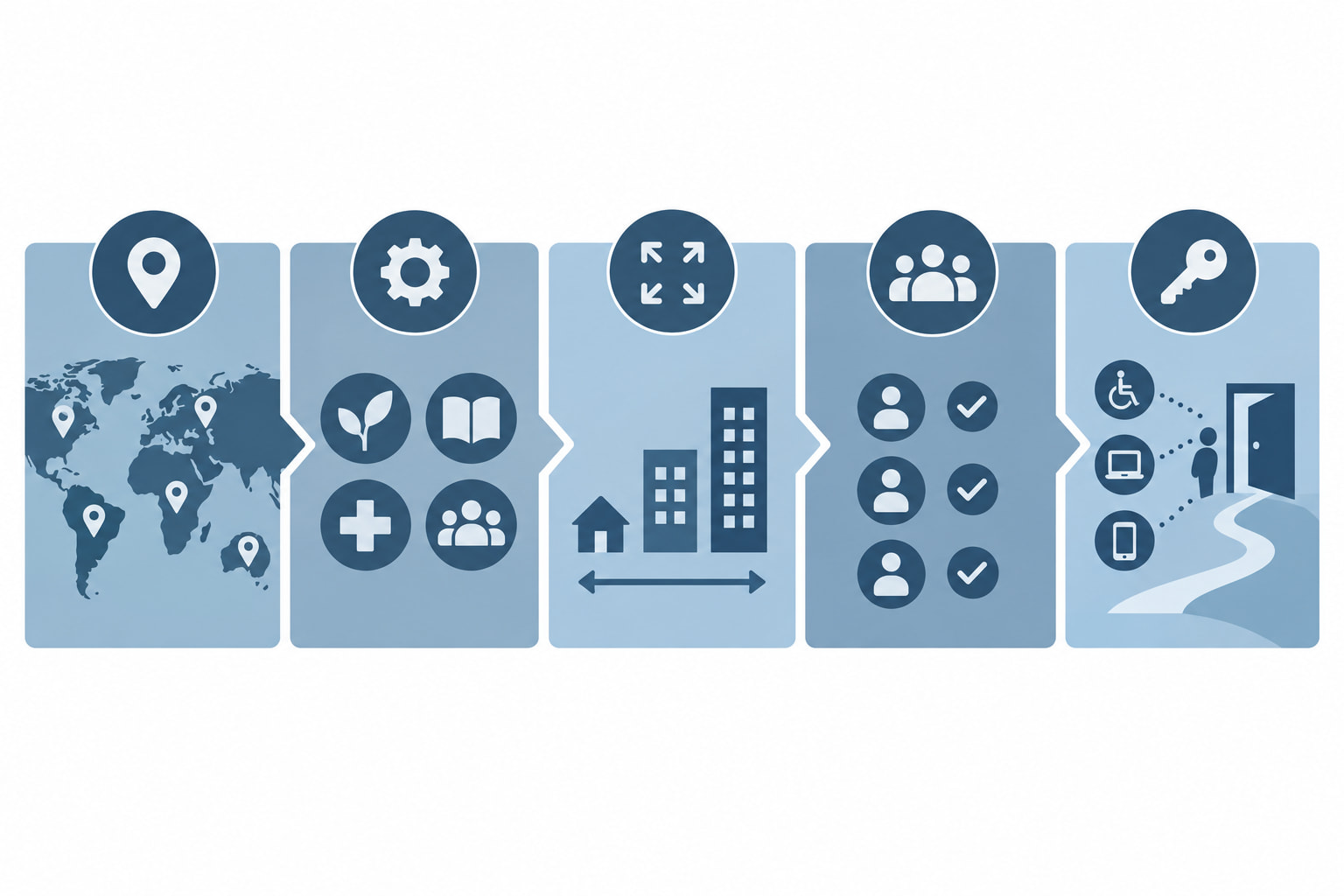
The check has five screens: geography, program area, grant size, stage and eligibility, and access. Each one has a public source that answers it.
Quick Answer: What Is a Funder Fit Check Before Applying?
A funder fit check before applying compares your location, program area, request size, eligibility and entry route against a funder's stated limits and past grants. A conflict on geography, eligibility or access ends the check. A conflict on program area or size means re-scope the request or move on. Apply when all five pass.
How to Run a Funder Fit Check Before Applying
A funder fit check before applying is a screen that compares your organization and project against a funder's public record before you write. It prevents weeks of work on applications the rules or the giving pattern already rule out.
Start with the funder's own guidelines page, then the foundation tax filing, then the past grant list. The guidelines state who may apply and for what. The filing states whether the funder considers new applicants at all. The grant list shows what the funder actually paid.
The 2025 Form 990-PF, Part XIV item 2, asks a private foundation to check a box if it only makes contributions to preselected charitable organizations and does not accept unsolicited requests for funds (IRS, 2025 Form 990-PF). A foundation that does not check that box must complete items 2a through 2d covering the person to whom applications should be addressed, the form applications should take, any submission deadlines, and any restrictions on awards such as geographic areas, charitable fields or kinds of institutions (IRS, 2025 Form 990-PF). That block alone answers two fit questions, so pull it before anything else, alongside the prospecting steps in the grant search guide.
Candid found that of the 112,733 U.S. private foundations that filed Forms 990-PF for fiscal year end 2023, 71% checked the preselected-only box, which narrowly interpreted means only 29% (fewer than 33,000 foundations) are open to considering new grantees (Candid, October 1, 2025). Candid notes that checking the box does not necessarily reflect a firmly fixed policy, as foundation staff may still consider unsolicited requests (Candid, October 1, 2025). Candid lists routes that closed foundations still leave open, including an introduction form on the website, letters of inquiry and a preliminary conversation (Candid, October 1, 2025). Treat the box as a strong signal, then read the guidelines for the exceptions.
Use one scoring sheet for every prospect so comparisons stay honest:
Score each dimension as a pass, a conflict, or an unknown. Geography, eligibility and access are hard bars, so one conflict there ends the check; on program area or size, a conflict means re-scope or move on.
Select to enlarge (opens in a new tab).
Geography Fit: Where the Funder Actually Gives
Geography fit is a match between where you operate and where the funder states it will pay. Commenters in three Reddit threads said "the biggest issue with finding new opportunities is geographic alignment" (Reddit threads 1r8eviy, 1vb5ctu and 1sewng0, read September 2026).
Read the geographic restriction first, because it is often a hard bar. The filing instructions require a foundation that is open to applications to state any restrictions or limitations on awards such as geographic areas, charitable fields or kinds of institutions (IRS, 2025 Form 990-PF). A guideline that names a county, a metro area or a state means what it says. A proposal from outside that boundary does not get scored on merit.
Then test the statement against the past grant list. Pull two or three years of awards and map the recipient cities. A funder that states a regional focus and whose grant list clusters inside that region has told you the policy is real.
Some programs write the service area into eligibility itself. DuPage Foundation restricts its Capacity Building grants to 501(c)(3) public charities that primarily serve DuPage County residents and that have received a grant within the last three years through its Community Impact or Arts DuPage programs (DuPage Foundation, page dated July 25, 2025). Walmart's Spark Good Local Grants require the organization to serve the same service area that the facility it is requesting funding from serves (Walmart.org, read September 2026). Those are service-area tests, not mailing-address tests, so a headquarters inside the line with programs outside it still fails.
If your service area sits outside the stated area, stop.
Program Area Fit: What the Funder Counts as In Scope
Program area fit is a match between what you propose and the charitable fields the funder names as current priorities. It is a vocabulary test as much as a topic test. Funders use their own labels, and your program must translate into theirs without stretching.
Start with the program pages, not the mission statement. A mission statement describes enduring values. Program pages describe what staff may pay for this year. Look for named strategies, excluded topics and population definitions. If the page names an outcome type the funder pays for, a proposal that cannot promise that outcome does not fit, however close the subject matter looks.
Pay attention to use restrictions inside otherwise broad programs. The Staunton Farm Foundation's 2026 capacity-building opportunity caps awards at $25,000 per request and explicitly excludes general operating support, capital construction, endowments, debt repayment, lobbying and fundraising events from allowable uses (Staunton Farm Foundation, 2026 opportunity). A program can welcome your field yet exclude your request type, amount or timing.
Candid advises that most grants, especially first-time grants, are restricted to program expenses, and that general operating or unrestricted grants "are largely the exception, rather than the rule" (Candid, March 25, 2024). A project framed as operations or reserves will read as out of scope to a funder that pays for direct program costs. Frame the request in the cost terms the program uses.
One commenter on Reddit diagnosed rejections as "no crystal clear outcomes that are linked confidently to the org's capacity and track record" (Reddit thread 1vf8jxw, read September 2026). The outcomes you promise must sit inside the field the funder pays for, with history that shows delivery. Generic community benefit language does not substitute.

Select to enlarge (opens in a new tab).
Grant Size Fit: Whether Your Ask Matches Past Awards
Grant size fit is a match between the amount you need and the amounts the funder actually pays. It is easy to skip because the ask feels negotiable. The grant list settles it.
Build a band from the most recent two or three years of awards and place your request inside the cluster, not at the edge. A funder whose past awards cluster at modest sizes will not stretch to a far larger request because the narrative is strong.
Use published medians as context, not as targets. In the 2025 State of Grantseeking Report covering 2024 data, the median total grant funding among respondents was $246,800 and the median largest individual award was $100,000 (GrantStation, 2025 report with 2024 data). In that same report, the median largest award from non-government funders was $55,000 against $300,000 from government funders and $516,800 for the federal government specifically (GrantStation, 2025 report with 2024 data). A small foundation ask and a federal ask live in different budgets, and one proposal budget cannot serve both without rework.
Program-level caps make the point sharper. DuPage Foundation's 2026 Capacity Building grant program awards a total of $120,000, with individual grants up to $20,000 (DuPage Foundation, 2026 guidelines). Walmart's Spark Good Local Grants award local cash grants ranging from $250 to $5,000 through individual Walmart United States stores, Sam's Clubs and Distribution Centers (Walmart.org, read September 2026). Each of those bands tells you the right request size before you budget.
Match the budget form to the funder type. A foundation will want a project budget tied to the outcomes in your evaluation plan. A federal opportunity will want compliant cost categories, a difference covered in the comparison of federal and foundation proposals.
Stage and Eligibility Fit: Who the Funder Will Fund
Stage and eligibility fit is a match between who you are today and whom the funder states it will pay. It covers tax status, operating history, budget size, staffing and governance. It is a pass or fail screen.
Tax status comes first. To be tax-exempt under section 501(c)(3), an organization must be organized and operated exclusively for exempt purposes set forth in section 501(c)(3), and none of its earnings may inure to any private shareholder or individual (IRS, page last reviewed June 28, 2026). A private foundation's grants to organizations are taxable expenditures unless the recipients are public charities or the foundation exercises expenditure responsibility with respect to the grant (IRS, page last reviewed June 28, 2026). If you lack public charity status, the route is a fiscal sponsor or a funder willing to exercise expenditure responsibility; without either, the inquiry ends there.
Candid's grant-readiness guidance asks three questions before you seek a foundation grant: are you a 501(c)(3) organization as defined by the IRS, do you have a track record, and do you have capable leadership and an effective board (Candid, March 25, 2024). Candid states that it is difficult (though not impossible) for a brand-new organization to get a grant (Candid, March 25, 2024). Those checks mirror what eligibility pages ask for.
Some bars are explicit and numeric. The Community Foundation's Rocco Legacy Endowment Capacity-Building Grants require the applicant to have at least three years as an established functioning entity offering services and programming aligned with its mission statement (The Community Foundation Harrisonburg and Rockingham, page dated May 12, 2026). The same Rocco program gives preference to organizations with revenue under $500,000 on the latest Form 990 and requires a 10 to 25 percent project cost contribution plus a board-chair letter (The Community Foundation Harrisonburg and Rockingham, page dated May 12, 2026). Read each bar literally.
Federal eligibility adds registrations that take calendar time. Submitting a SAM registration and getting a Unique Entity ID are both free (SAM.gov, read September 2026). SAM.gov states that registration must be renewed every 365 days to stay active (SAM.gov, read September 2026), and the Federal Service Desk says to allow at least ten business days after submission for it to become active (Federal Service Desk, 2.4 Quick Start Guide for Grant Registrations, read September 2026). Grants.gov states that an organization must register as an entity with SAM before anyone can start applying in Grants.gov (Grants.gov, read September 2026). Start that clock early.
Relationship and Access Fit: Whether You Can Get in the Door
Access fit asks whether you have a path to enter. A strong program match with no entry route is still a no.
Size does not close the door; the data points the other way. Candid identified 1,744 private foundations with assets above $100 million, of which 38 percent accepted unsolicited requests for funds, 9 percentage points higher than private foundations overall (Candid, October 1, 2025). Candid's 2025 Foundation Giving Forecast Survey asked 522 private and community foundations whether they accepted unsolicited proposals and 55 percent said they were willing to do so, including 56 percent of private foundations and 48 percent of community foundations (Candid, October 1, 2025). The distance between what the filings show and what foundations say in a survey is where careful reading of the current guidelines pays off.
The Ford Foundation states it does not accept unsolicited grant proposals by mail, email or phone (Ford Foundation, read September 2026). The Weingart Foundation states it uses an invitation-only process in order to reduce the burden on applicants and expedite funds while still inviting contact with a program officer (Weingart Foundation, read September 2026).
Map the entry route before you draft, with the same discipline our proposal-writing walkthrough applies to the narrative. Commenters in three Reddit threads said "a proposal shouldn't be the first time a funder hears about your organization" (Reddit threads 1vf8jxw, 1r8eviy and 1pzk4ub, read September 2026), and workarounds listed in two of them included asking current funders for referrals and working the board for introductions (Reddit threads 1r8eviy and 1pzk4ub, read September 2026).
GrantCue covers the public-data half of this screen: a directory of more than 10,000 private foundation profiles built from IRS 990-PF public filings, filterable by whether a foundation indicates it accepts applications, beside live federal, state and foundation listings, with fit scoring on every plan, Free included (grantcue.com, October 2026). Open each candidate's profile in the directory and compare the stated area, program and entry route against your sheet before you write.
Put the Five Screens Into a Go Decision
A go decision states whether to apply, with one evidence line per screen.
Apply when geography, program, size, eligibility and access all pass on public evidence. Pause when one screen is unknown and name the document that would resolve it, with a date to find it. Decline when geography, eligibility or access fails, even if the deadline feels urgent, and re-scope or move on when program area or size conflicts. Volume does count for something: in GrantStation's 2026 State of Grantseeking Report, organizations submitting one application had a 64.5 percent award rate against 99.4 percent for those submitting more than 30, from a self-selected sample of 1,354 organizations in a survey GrantStation itself says "was not scientifically conducted" (GrantStation, 2026 report with 2025 data, and GrantStation methodology, read September 2026). Read that as an argument for applying more often, not for applying anywhere. The fit screen decides which prospects earn the hours.

Select to enlarge (opens in a new tab).
FAQ
How Do You Check Funder Fit Before Applying for a Grant?
Compare your location, program area, request size, eligibility status and entry route against the funder's guidelines, filing checkbox block and past grant list. Score each of the five as a pass, a conflict or an unknown. Apply when all five pass on public evidence. Stop at any conflict on geography, eligibility or access, and re-scope or move on when program area or size conflicts.
What Is Geographic Fit in Grant Prospecting?
Geographic fit means your service area sits inside the area the funder states it will pay for. On the 2025 Form 990-PF, a private foundation open to applications lists any restrictions, such as geographic areas, in Part XIV items 2a through 2d (IRS, 2025 Form 990-PF). Read that restriction first, then map two or three years of recipient locations. Service-area rules count where you deliver programs, not where your office sits.
How Do You Tell If Your Program Fits a Foundation's Priorities?
Quote the funder's current program category, then link your project to it in one sentence. Check past award descriptions to see how broadly staff read that category. If you cannot quote the category, or the link needs a paragraph of explanation, the fit is weak and another prospect deserves the slot.
What Grant Size Should You Request From a Foundation?
Request an amount inside the cluster where most of the funder's recent awards sit, not at the edge or above the maximum. Build the band from two or three years of awards, noting the smallest, largest and typical grant. Match the budget form to the funder type.
How Do You Know If a Foundation Accepts New Applicants?
On the 2025 Form 990-PF, Part XIV item 2 is the box a private foundation checks if it only funds preselected organizations (IRS, 2025 Form 990-PF). Candid found 71% of filers for fiscal year end 2023 checked it, which narrowly interpreted leaves 29% (fewer than 33,000 foundations) open, and notes the box "doesn't necessarily reflect a firmly fixed policy" (Candid, October 1, 2025). Read the current guidelines for the entry route.
What Does Eligibility Fit Cover Before a Grant Application?
Eligibility fit covers tax status, operating history, budget size, staffing and governance bars the funder published. It also covers registrations for federal awards, since a Unique Entity ID alone cannot support a direct federal application (SAM.gov, read September 2026). Read each bar literally and stop when one fails.
File the Sheet and Apply Only Where the Record Aligns
File the fit sheet and apply only where all five screens pass on public evidence. Keep the five evidence lines per prospect, with the filing year and guideline date attached. Browse open grant opportunities for candidates that meet that bar, then give the hours you saved to the next strong-fit prospect.