Foundation Application Information 2026
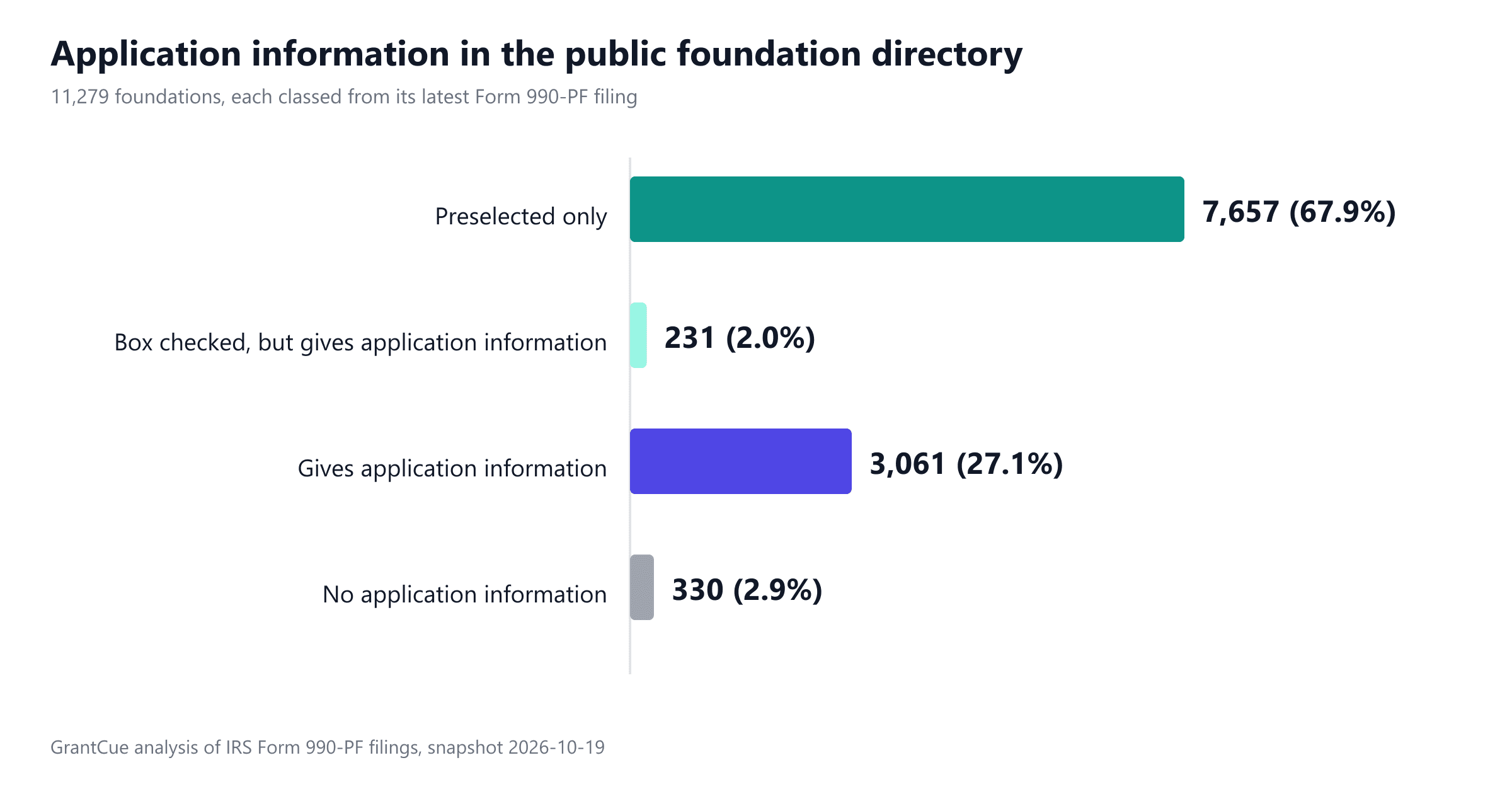
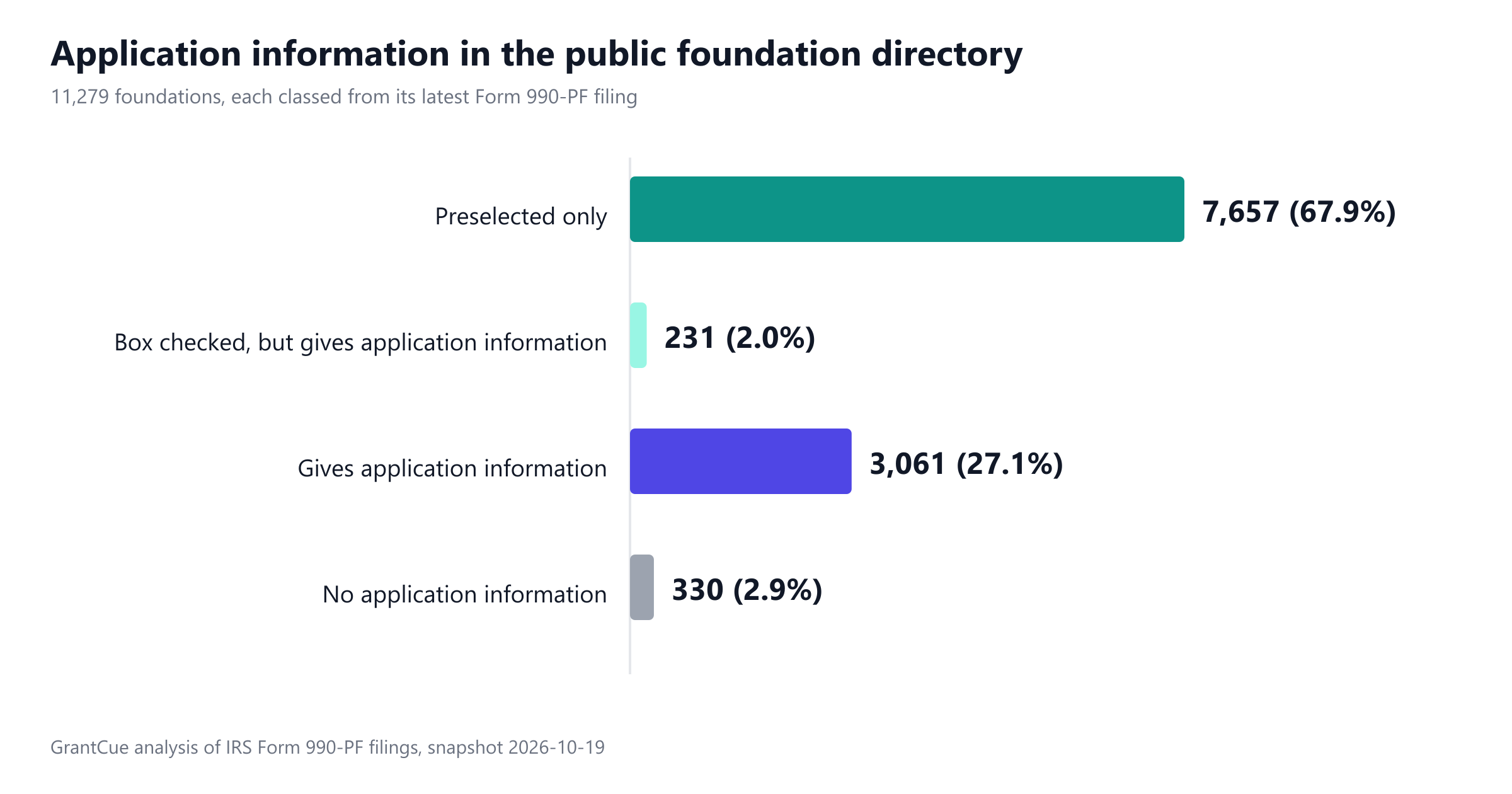
About 27% of the 11,279 private foundations in GrantCue's public directory give application information on their latest Form 990-PF filing, and that group paid about 40% of these foundations' grants in tax year 2024.
By GrantCue Team · Published October 2026; data snapshot 2026-10-19
Key findings
- About 27% give application information. 3,061 of the 11,279 foundations (27.1%) did not check the preselected box and gave at least one real application detail, such as a form, a deadline or a web address, on their latest filing. Another 7,657 (67.9%) checked the box and gave nothing else.
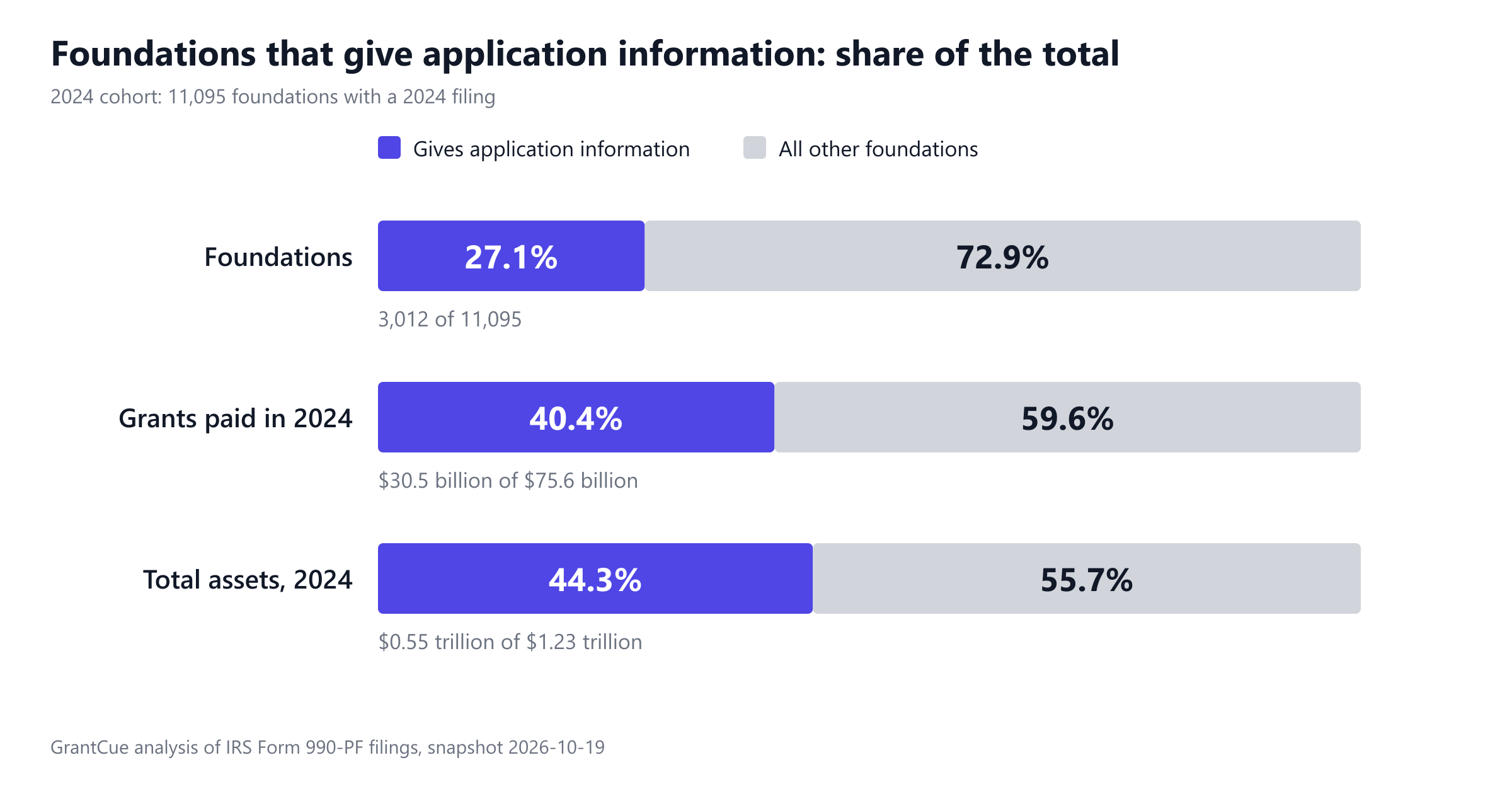
- That group holds about 40% of 2024 giving and 44% of assets. Among the 11,095 foundations with a tax-year-2024 filing, the 3,012 that give application information (27.1%) paid $30.5 billion of $75.6 billion in 2024 grants (40.4%) and held $546.0 billion of $1.23 trillion in assets (44.3%).
- The share rises with size. In the smallest quartile by 2024 assets, 20.6% of foundations give application information; in the largest, 34.6% (2,773 to 2,774 foundations in each quartile).
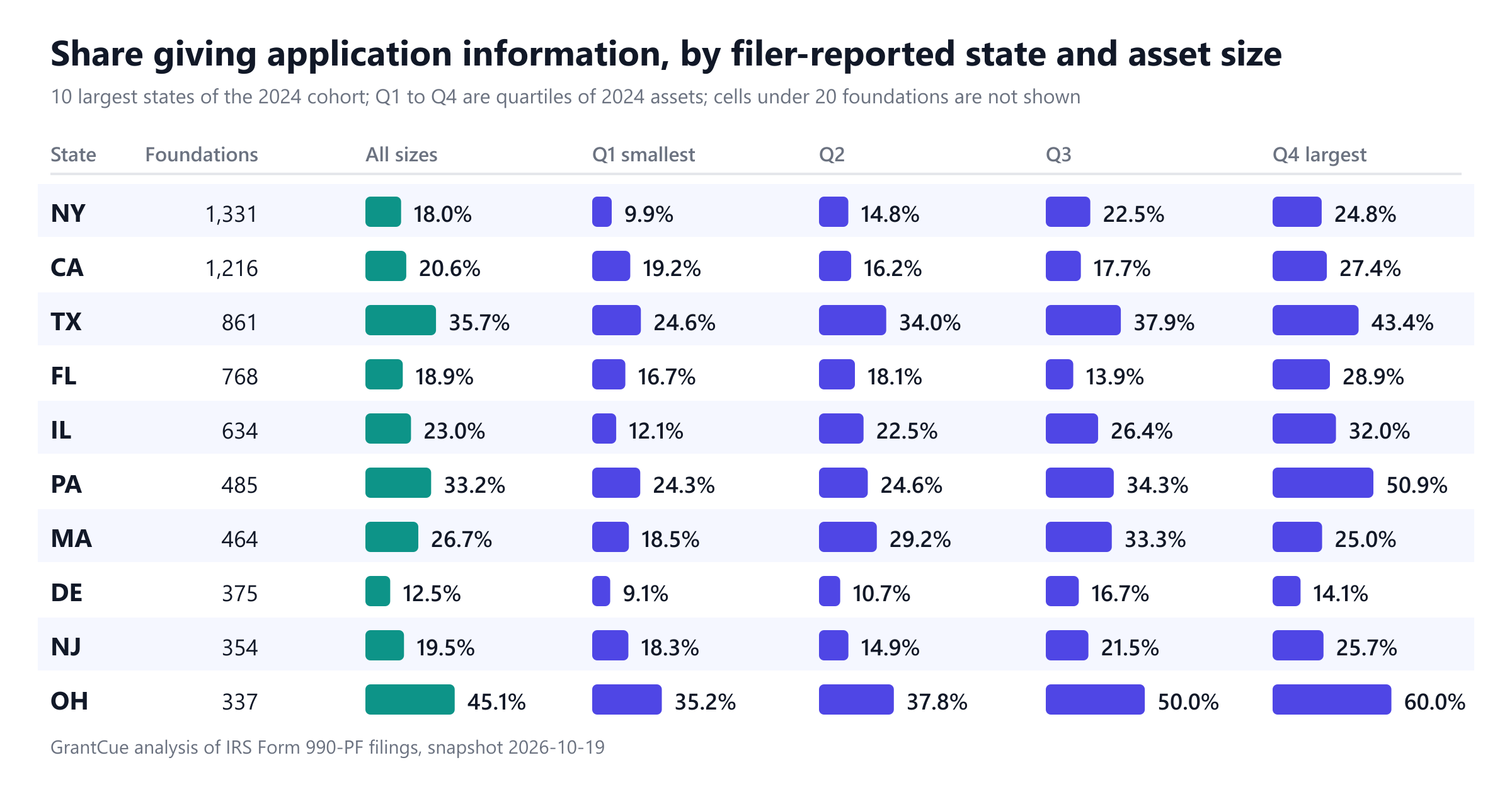
- States differ at every size. Among the ten filer-reported states with the most foundations, the share ranges from 12.5% in Delaware (47 of 375) to 45.1% in Ohio (152 of 337). Ohio's share is above Delaware's and New York's in every asset quartile, so size alone does not explain the spread.
- Non-answers change the count. 401 foundations filled in the application lines with nothing but non-answers such as "N/A", "NONE" or "SEE STATEMENT". Counting any text at all as information would put the share at 30.0% instead of 27.1%.
Who is counted
This report covers the 11,279 private foundations in GrantCue's public foundation directory, not all U.S. foundations. A foundation is in the directory when its filings in our corpus add up to at least $1 million in grants paid across at least 5 grants. Both figures are cumulative over every return we hold for the foundation, from one to four returns: 4,480 foundations have one, 6,581 have two, 200 have three and 18 have four. Foundations below that bar are not counted, and neither are community foundations and other public charities, which file Form 990 instead of Form 990-PF.
The corpus is the Form 990-PF e-file returns the IRS publishes in its Form 990 series downloads, parsed by GrantCue. Each foundation is classed from its latest return: tax year 2024 for 6,047 foundations, 2025 for 5,063, 2023 for 166 and 2022 for 3. Money and size comparisons use tax year 2024 only.
Four classes
Part XIV, Line 2 of Form 990-PF (the numbering for tax years 2021 on; earlier forms called it Part XV) starts with a box a foundation checks if it "only makes contributions to preselected charitable organizations". Otherwise the form asks who applications should go to, what form they should take and what they should include, any submission deadlines, and any restrictions on awards.
We class each foundation by two things on its latest filing. The first is the box: "checked" or "not recorded as checked". In the stored data the box is either marked or absent, never an explicit "no", so an unchecked box looks the same as a missing section. The second is whether the filing gives application information: a form and materials text, a deadlines text or a submission web address that says something real. Answers such as "N/A", "NONE" or "SEE STATEMENT" don't count (see Method).
Each class is a reading of the foundation's latest filing, not a statement that it is taking applications now.
- Preselected only: the box is checked and the filing gives no application information. This is two thirds of the directory.
- Box checked, but gives application information: 231 of the 7,888 foundations that checked the box (2.9%) also describe a form, a deadline or a web address. The filing says two things at once.
- Gives application information: the box is not recorded as checked and the filing gives application information. This is 3,061 of the 3,391 foundations whose box is not recorded as checked (90.3%).
- No application information: the box is not recorded as checked and the filing gives nothing that counts. 324 of these 330 foundations list a contact but wrote only non-answers in the application lines; the other 6 left the section blank.
3,733 foundations give a contact name, address, phone number or email. A contact alone does not count as application information, and no contact details are in the published files.
Money and size, tax year 2024
Of the 11,279 foundations, 11,095 have a tax-year-2024 return. The other 184 are left out of every money, size and state figure in this report. Within this 2024 cohort the classes split almost exactly as in the whole directory: Preselected only 7,534 (67.9%), Box checked, but gives application information 223 (2.0%), Gives application information 3,012 (27.1%), No application information 326 (2.9%).
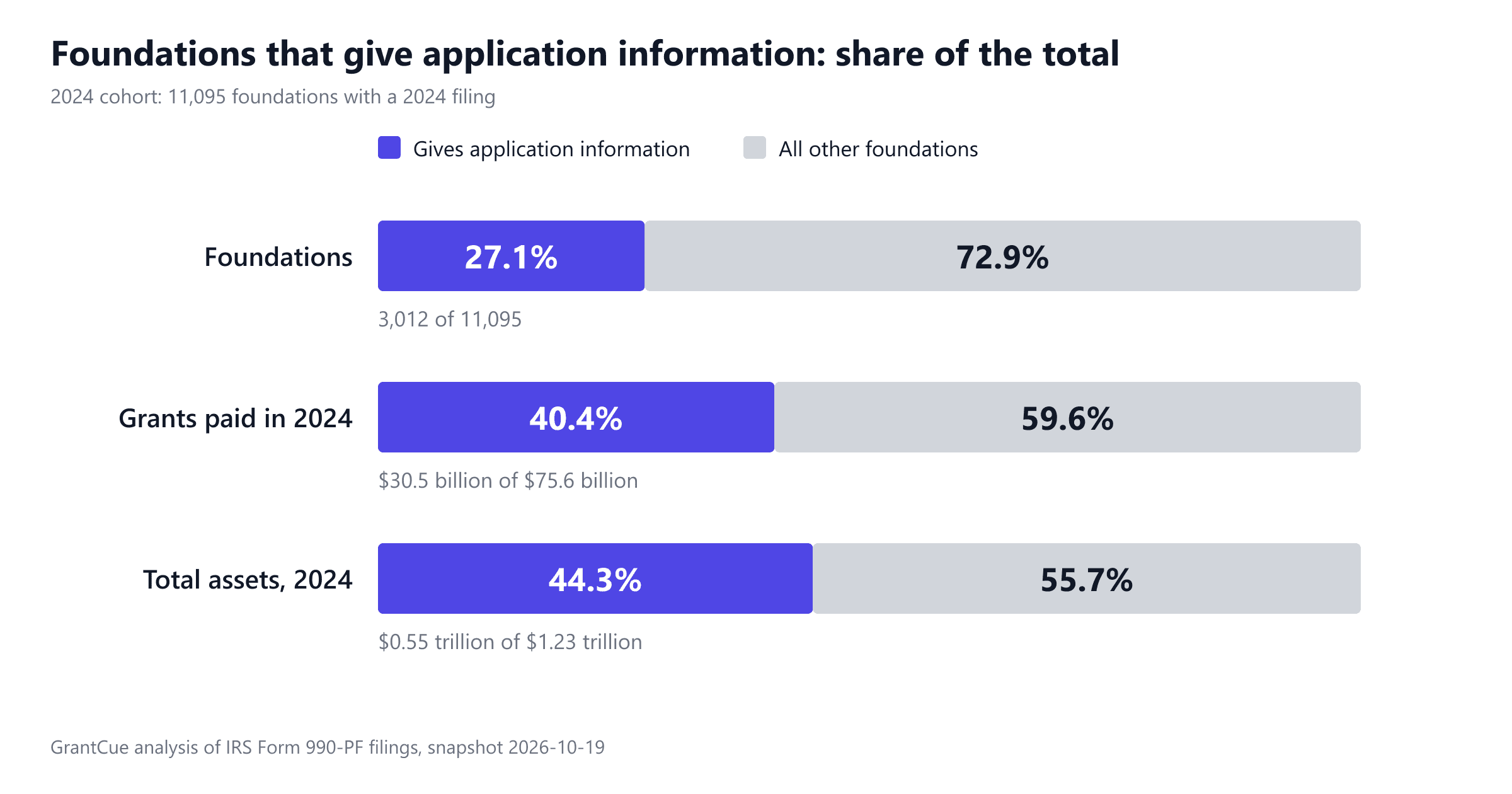
Foundations that give application information are larger on average. The median one paid $1.74 million in grants in 2024 and held $28.4 million in assets; the median preselected-only foundation paid $1.46 million and held $19.2 million. The group's share of 2024 grants paid (40.4%) is above its share of foundations (27.1%) but below its share of assets (44.3%): it gives more because its foundations are larger, not because they paid more in grants per dollar of assets. Preselected-only foundations, 7,534 of the 11,095 (67.9%), paid 54.4% of 2024 grants and held 49.7% of assets.
The share that gives application information rises with size. We split the cohort into four equal groups (quartiles) by total assets on the 2024 return:
Grants paid and assets come from each foundation's 2024 return, not from the directory's cumulative totals. Assets are total assets at fair market value as filed. 85 foundations filed a 2024 tax period shorter than 360 days, including 24 that filed more than one 2024 period (their grants are summed, and their assets and state are taken from the latest period). Leaving all 85 out moves the three shares above by less than 0.3 points, to 27.2%, 40.6% and 44.4%.
By filer-reported state
Geography here is the filer-reported state: the state in the address on the foundation's 2024 return. It is not where the foundation gives, and not necessarily where it is run. Filer addresses can be a trustee's office. All 50 states, the District of Columbia and Puerto Rico appear in the cohort; 49 of them have at least 20 foundations, and states.csv gives the figures for each, with any group under 20 left blank.
The ten largest states hold 6,825 of the 11,095 foundations (61.5%). Among them the share that gives application information ranges from 12.5% in Delaware to 45.1% in Ohio. Ohio, Texas and Pennsylvania are above a third; New York (18.0%) and Delaware (12.5%) are the lowest. In all ten states the largest asset quartile has a higher share than the smallest, but the rise is not steady everywhere: California and New Jersey dip from Q1 to Q2, Florida from Q2 to Q3, and Massachusetts and Delaware from Q3 to Q4. The gaps between states hold within each quartile: in the smallest, 35.2% of Ohio's foundations give application information against 9.9% of New York's; in the largest, 60.0% against 24.8%. Each quartile cell holds 70 to 365 foundations, so a difference of a few points between two cells may be chance.
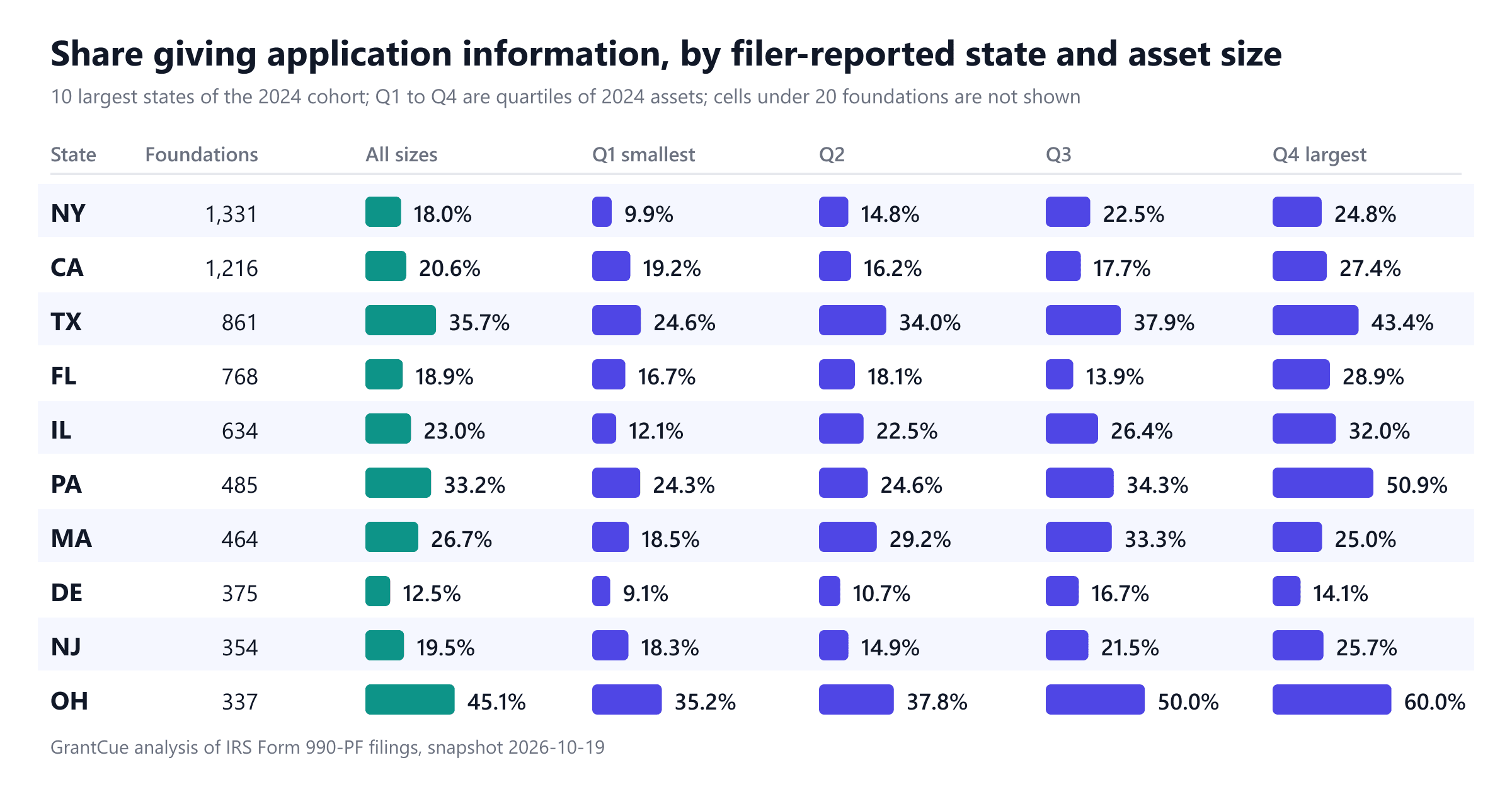
The "All foundations" row includes the 15 cohort foundations whose 2024 return gives no state.
What this means for grant seekers
- Check the foundation's own site before you write. A filing describes the past: the latest returns here are for tax years 2022 to 2025, and a foundation can change its deadlines or close a program between returns. "Gives application information" means the filer wrote down how to apply, not that it is taking applications today.
- Read a checked box as the foundation's own statement that it chooses its grantees. Two thirds of the directory (7,657 of 11,279) checked it and gave nothing else. Unless you already have a connection or an invitation, put these foundations after the others.
- Treat "Box checked, but gives application information" as unclear. These 231 filings say two things at once. The foundation's website, or a short question to it, will tell you which one holds.
- A listed contact is not an invitation. 324 of the 330 foundations with no application information still list a contact. If you write to one, ask whether and how it considers requests instead of sending a full proposal.
- Don't skip the largest foundations. The share that gives application information rises from 20.6% in the smallest asset quartile to 34.6% in the largest.
- Look at where a foundation gives, not where it files. A filer-reported state is an address on a return. Each directory profile lists the foundation's top recipient states and its largest grants, which tell you more about fit.
- Check fit before process. The classes don't consider restrictions on awards, such as a region, a subject or a type of organization. Read those in the foundation's guidelines first.
Method
Source and snapshot
The data comes from Form 990-PF e-file returns published by the IRS and parsed by GrantCue. The files were written from GrantCue's database on 2026-10-19 in one read-only transaction; the foundation profiles had last been rebuilt on 2026-10-18. The files are frozen: their figures will not change. snapshot.json records the run and identifies the exact version of the script that produced them.
Which filing
For each foundation we use its latest filing: the highest tax year, then the latest period end, then the latest filed date. Where the corpus holds more than one copy of a return for the same foundation and period, we keep the copy filed last. The box and the application texts come from that one filing.
The box
"Checked" means the filing marks the box for giving only to preselected organizations. Everything else is "not recorded as checked". The stored data never holds an explicit "no" (in the 52 filings we read by hand, the mark was simply absent), so an unchecked box and a missing section can't be told apart, and we call neither one "no".
Application information and non-answers
Three of the filing's application texts count: the form and materials text, the deadlines text and the submission web address field. A filing gives application information when at least one of them says something real, or when any of them holds a web address (http://, https:// or www.).
A text is a non-answer, and doesn't count, when after trimming, ignoring case and dropping trailing punctuation it is only:
- an empty answer: "N/A", "NA", "NONE", "NONE SPECIFIED", "NOT SPECIFIED", "NOT APPLICABLE", "NO", "UNKNOWN", a dash or a zero;
- a statement that there is no form or no deadline, such as "NO SPECIFIC FORM", "NO REQUIRED FORMS", "NO DEADLINES" or "THERE ARE NO SUBMISSION DEADLINES";
- the same answers repeated, such as "NONE NONE" or "N/A N/A";
- a pointer to somewhere else: "SEE STATEMENT", "SEE ATTACHED", "SEE ABOVE", "SEE SCHEDULE" or "SEE PART" followed by a reference, "SEE FOOTNOTE", or "SEE WEBSITE" with no address.
A text that holds a web address is never a non-answer, so "SEE WEBSITE" followed by an address counts. Texts that say how to ask, such as "LETTER", "LETTER OF INQUIRY" or "IN WRITING", count. The full list and the patterns are in snapshot.json.
Raw and filtered counts
The classes in this report use the filtered rule above. The files also give each foundation's class under a raw rule, where any stored text counts, however short. The filter moved 324 foundations from "Gives application information" to "No application information" and 77 from "Box checked, but gives application information" to "Preselected only"; it moved no others. In all, 401 foundations had application text that was nothing but non-answers. For 87 of them at least one text was only a pointer: "SEE WEBSITE" (4 foundations), "SEE FOOTNOTE" (25) or a reference to another place in the filing (58).
GrantCue's directory filter for foundations that give a way to apply covers 3,385 foundations, the same foundations as the raw count. 324 of them (9.6%) wrote only non-answers, and every one of those 324 lists a contact.
Web addresses are found in the three texts themselves. 687 foundations have one (655 in "Gives application information", 32 in "Box checked, but gives application information"). For 508 of them the stored submission web address field has no https:// address, so that field alone would miss them (see the hand check below). The addresses themselves are not in the files.
Money, size and state
Money and size figures use the 11,095 foundations with a tax-year-2024 return; 184 without one are left out. Grants paid, grant counts and assets come from the 2024 return. A foundation with more than one 2024 period has its grants summed and its assets and state taken from the latest period. Asset quartiles are cut at $8,718,184.50, $21,398,115 and $51,443,108.50; a value equal to a cut point goes to the higher quartile. One foundation reports negative assets (minus $4,839) and is kept as filed. A state, or a state within a quartile, with fewer than 20 foundations is left blank in states.csv. Three are blank as a whole (Alaska, North Dakota and Puerto Rico), as is the group of 15 foundations with no state.
Hand check of 52 filings
We read 52 latest filings directly from the IRS e-file XML and compared them with the stored values. They were drawn from the four classes as read before the filter, in a fixed order set by a hash of each EIN: 18, 10 and 18 filings from the first three classes and all 6 in "No application information". 29 are for tax year 2024 and 23 for 2025.
- All 52 matched on the box and on whether a form, a deadline and a contact were given. Every checked filing in the sample has the box marked in the XML, and every other filing has no box mark at all, never an explicit "no".
- About a quarter of the "information" entries in the sample were placeholders: of the 28 sampled filings with any application text, 7 (25%) had only text such as "N/A", "NONE" or "NO SPECIFIED FORM" (5 of the 10 with the box checked, 2 of the 18 without). That is why the filter exists.
- The stored submission web address missed http:// and www. addresses: all 4 sampled filings whose text held an address had an empty stored address. That is why web addresses are detected in the text.
- One filing listed several application programs, and only the first is stored.
This is a check, not an error rate. 52 filings across four classes are too few to measure one.
Limitations
- Filings lag real activity by a year or more, and a foundation's policy can change before its next return.
- The classes describe what the filer wrote. We don't check them against foundation websites.
- When a return lists several application programs, only the first is stored, so the class describes that one.
- The filter is narrow on purpose. Short texts that say little but are not empty answers still count as information, for example "AVAILABLE UPON REQUEST" (14 fields), "PROVIDED UPON INITIAL CONTACT" (10), "VARIOUS" (9) and "ROLLING" (5).
- The classes don't consider restrictions on awards or who is eligible.
- The population is chosen by the size of past giving, so it is not a sample of all private foundations.
- A filer-reported state is the address on a return, not a headquarters and not where grants go.
- Amounts and assets are as the foundations filed them. We don't audit them.
What we did not do
- We did not check whether any foundation is taking applications now, and we did not contact foundations.
- We did not measure where grants went, or combine years for money and size.
- We did not publish contact names, phone numbers, email addresses, web addresses or any application text from the filings.
- We did not test differences for statistical significance.
Downloads
All files are a frozen snapshot from 2026-10-19 and use the class codes preselected_only (Preselected only), preselected_but_info (Box checked, but gives application information), application_info (Gives application information) and no_info (No application information). The same files, with a DOI, are on Zenodo.
foundations.csv: one row for each of the 11,279 foundations (about 3 MB): EIN, name, profile link, the tax year of its latest filing, the box, which application details it gives, its class under both rules, cumulative totals, 2024 grants and assets, asset quartile and filer-reported state.states.csv: class counts, shares, 2024 grants paid and 2024 assets for each filer-reported state, for all sizes and for each asset quartile; groups under 20 foundations are blank.data-dictionary.csv: every column of both CSV files, with its definition and source.snapshot.json: every figure on this page, the definitions, the full non-answer list and patterns, the quartile cut points, the exclusions and the run details.chart-classes.png: the four classes across all 11,279 foundations.chart-dollars.png: the share of foundations, 2024 grants paid and 2024 assets held by foundations that give application information.chart-states.png: the share that gives application information in the ten largest filer-reported states, by asset quartile.LICENSE.txt: what the license covers and how to credit GrantCue.README.txt: a short description of the files, their source and how to cite them.
Use a chart on your site
To use a chart, copy its code. Please keep the credit line.
chart-classes
<figure style="margin:0;max-width:100%">
  <img src="https://www.grantcue.com/research/foundation-application-information-2026/chart-classes.png" width="1200" height="630" style="max-width:100%;height:auto" alt="Bar chart of 11,279 private foundations by what their latest Form 990-PF filing says about applying: Preselected only 67.9%, Box checked, but gives application information 2.0%, Gives application information 27.1%, No application information 2.9%.">
  <figcaption>Chart: <a href="https://www.grantcue.com/research/foundation-application-information-2026">GrantCue, Foundation Application Information 2026</a>, <a href="https://creativecommons.org/licenses/by/4.0/" rel="license">CC BY 4.0</a></figcaption>
</figure>
chart-dollars
<figure style="margin:0;max-width:100%">
  <img src="https://www.grantcue.com/research/foundation-application-information-2026/chart-dollars.png" width="1200" height="630" style="max-width:100%;height:auto" alt="Foundations that give application information on their Form 990-PF: 27.1% of 11,095 foundations with a 2024 filing, 40.4% of their 2024 grants paid and 44.3% of their 2024 assets.">
  <figcaption>Chart: <a href="https://www.grantcue.com/research/foundation-application-information-2026">GrantCue, Foundation Application Information 2026</a>, <a href="https://creativecommons.org/licenses/by/4.0/" rel="license">CC BY 4.0</a></figcaption>
</figure>
chart-states
<figure style="margin:0;max-width:100%">
  <img src="https://www.grantcue.com/research/foundation-application-information-2026/chart-states.png" width="1200" height="630" style="max-width:100%;height:auto" alt="Share of private foundations that give application information on their Form 990-PF, ten largest filer-reported states, by 2024 asset quartile: from 12.5% in Delaware to 45.1% in Ohio.">
  <figcaption>Chart: <a href="https://www.grantcue.com/research/foundation-application-information-2026">GrantCue, Foundation Application Information 2026</a>, <a href="https://creativecommons.org/licenses/by/4.0/" rel="license">CC BY 4.0</a></figcaption>
</figure>
How to cite and reuse
To cite this report:
GrantCue Team, Foundation Application Information 2026. GrantCue, 2026. https://www.grantcue.com/research/foundation-application-information-2026. Licensed under CC BY 4.0. https://doi.org/10.5281/zenodo.23475478
Reuse
GrantCue's foundation data is open. The directory download, the Foundation Application Information 2026 report with its charts and data files, and the methodology are licensed under CC BY 4.0: you may copy, share, adapt and build on them for any purpose, including commercial use, as long as you credit GrantCue. The rest of the site, including the foundation profiles, the blog and the templates, is covered by our Terms of Service. Download the whole directory as CSV: one row per foundation, with grants paid, grant counts, median grant, top recipient states and a link to each profile.
The license covers GrantCue's own work: our text and charts, the figures we compute, and the way the data is selected and arranged. It does not cover the facts themselves, which come from public IRS filings and belong to no one; you need no permission from us to use them, though we ask for credit. It also does not cover words the foundations wrote, such as a grant's stated purpose or their application instructions.
To credit us, name GrantCue, link to the page or file you used, and mention CC BY 4.0. If you changed the data, say so. To cite the directory:
GrantCue Foundation Directory, compiled from IRS Form 990-PF filings 2021–2025. https://www.grantcue.com/foundations. Method: https://www.grantcue.com/methodology. Licensed under CC BY 4.0.
Corrections
Found something wrong? Write to support@grantcue.com, with the foundation's EIN if it concerns one foundation. If we correct a figure, the change is dated on this page and the corrected files are published as a new version. How we correct errors is in our editorial policy.
Every foundation counted here has a free profile in the GrantCue foundation directory, with its giving and what its latest filing says about applying.