Grants Lifecycle Management: A Nonprofit Guide From Discovery to Closeout
A practical guide to grants lifecycle management for nonprofits, covering discovery, qualification, proposal development, award tracking, reporting, closeout, and software workflows.
Last updated: July 2026
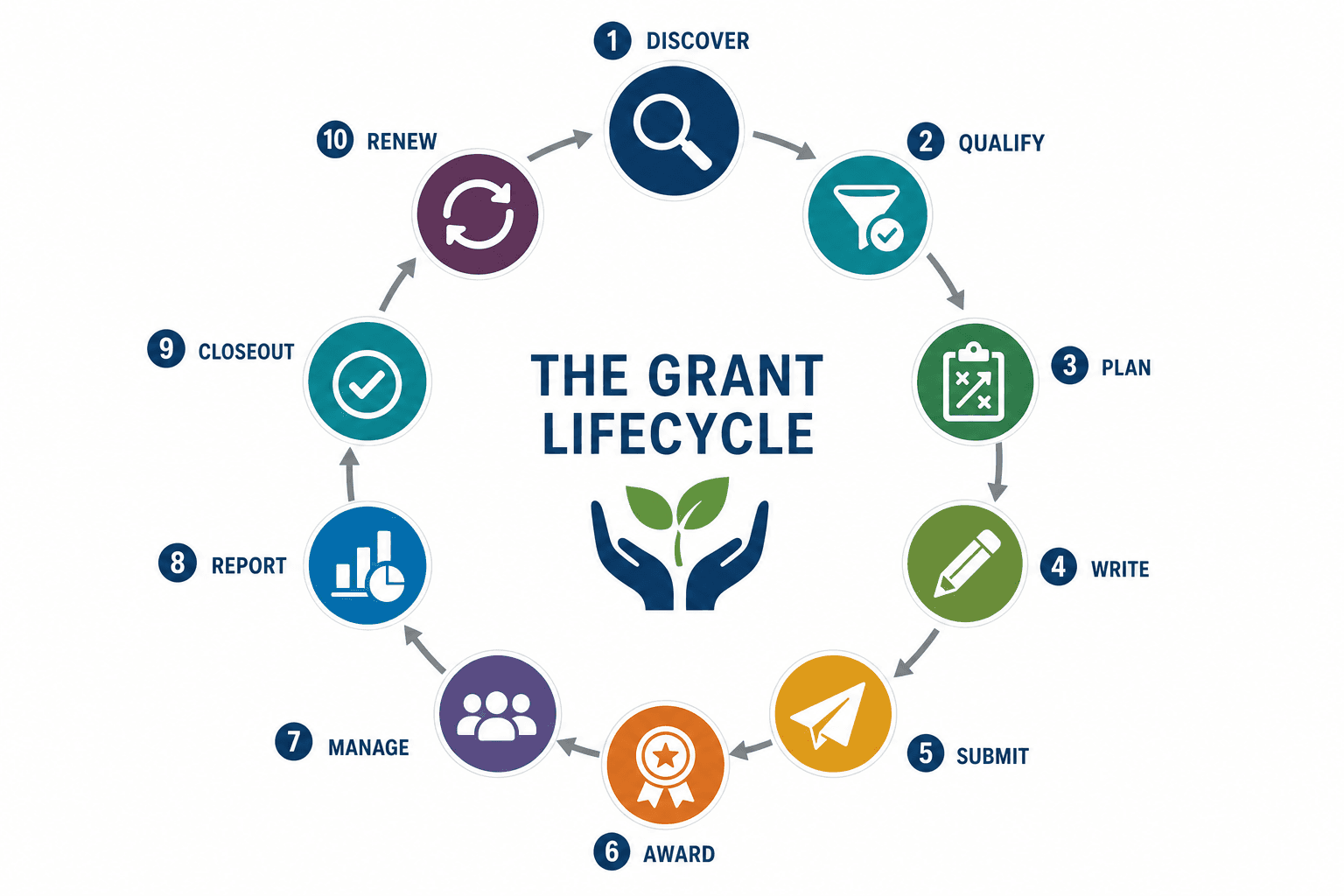
Grants lifecycle management is the full process of finding grant opportunities, deciding whether to apply, writing and submitting proposals, managing awards, reporting results, closing out grants, and preparing for renewals. For nonprofits, the lifecycle matters because grant revenue does not end when the award letter arrives.
GrantCue helps teams manage the grant lifecycle by connecting discovery, pipeline tracking, deadlines, documents, AI writing, reporting, and post-award work.
Quick Answer: What Are the Stages of the Grant Lifecycle?
| Stage | What Happens |
|---|---|
| Discovery | Find possible grants |
| Qualification | Decide whether each grant is a fit |
| Planning | Confirm project, budget, owners, and timeline |
| Proposal development | Draft and review the application |
| Submission | Submit before the deadline |
| Award setup | Record terms, budget, reporting dates, and restrictions |
| Post-award management | Track spending, outcomes, documents, and reports |
| Closeout | Submit final reports and archive records |
| Renewal | Decide whether to reapply or deepen funder relationship |
Why Lifecycle Management Matters
Many nonprofits manage pre-award work separately from post-award work. The grant writer tracks applications, finance tracks spending, program staff track outcomes, and leadership asks for updates. That separation creates risk.
A lifecycle process reduces:
- Missed deadlines.
- Duplicate applications.
- Confusing document versions.
- Weak handoffs from proposal to program.
- Reporting surprises.
- Lost funder history.
- Renewal opportunities that slip away.
The goal is one continuous record from first discovery through final closeout.
Stage 1: Discovery
Discovery is the process of finding potential funders. A strong discovery process includes:
- Saved searches.
- Local and state funding sources.
- Foundation opportunities.
- Government notices.
- Funder history.
- Internal referrals from program staff.
- Eligibility filters.
Grant discovery should feed directly into the pipeline, not into a separate list that nobody checks.
Stage 2: Qualification
Qualification decides whether a grant deserves time. Use a short scorecard:
| Question | Why It Matters |
|---|---|
| Are we eligible? | Avoids wasted writing |
| Does the project fit? | Improves win probability |
| Can we meet the deadline? | Protects staff time |
| Can we manage the award? | Reduces compliance risk |
| Is the request amount worth it? | Prioritizes capacity |
| Do we have required documents? | Prevents late scrambling |
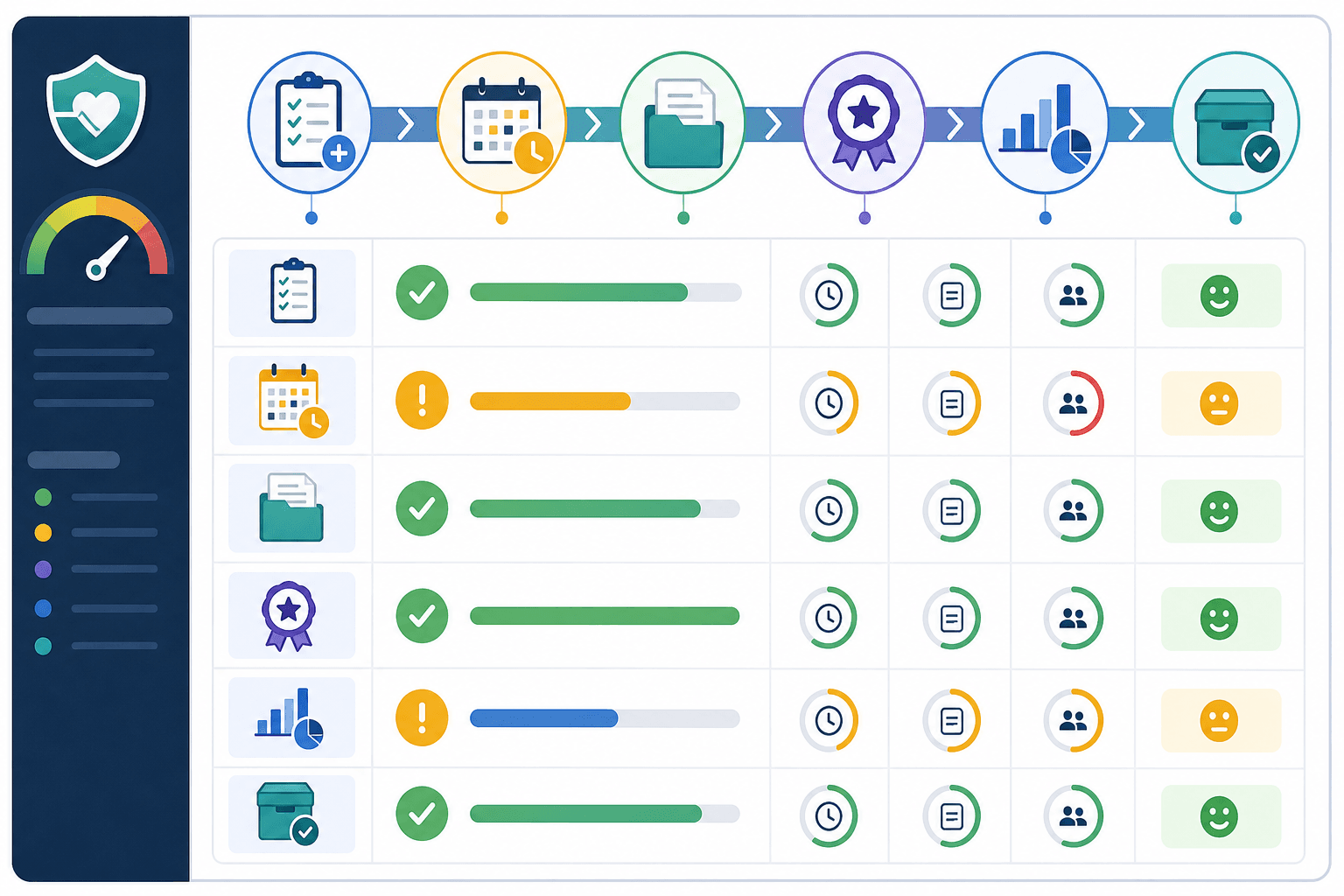
This is a natural place to use a grant lifecycle health check.
Stage 3: Proposal Development
Proposal development includes the narrative, budget, attachments, internal review, and final submission. It should connect to:
- The grant calendar.
- The proposal template.
- The budget owner.
- Required attachments.
- AI writing support.
- Review approvals.
Strong proposal work prepares the post-award phase. If the proposal promises outcomes, reporting methods, staffing, and budget categories, those details should become award management tasks if funded.
Stage 4: Award Setup
Award setup is the bridge between "we won" and "we can manage this." Capture:
- Award amount.
- Grant period.
- Restricted uses.
- Budget categories.
- Payment schedule.
- Reporting dates.
- Required metrics.
- Contacts.
- Grant agreement.
- Match requirements.
Do this immediately after award. Waiting until the first report is due creates unnecessary pressure.
Stage 5: Post-Award Management

Post-award management tracks whether the nonprofit is using funds correctly and delivering promised results. Use the post-award grant management checklist for a dedicated workflow.
At minimum, track:
- Spending against budget.
- Program activities.
- Participant counts.
- Outcomes.
- Required reports.
- Funder communications.
- Change approvals.
- Key documents.
Stage 6: Closeout
Closeout completes the grant record. Use a grant closeout checklist to confirm:
- Final report submitted.
- Final expenses reconciled.
- Unspent funds resolved.
- Outcomes documented.
- Required records archived.
- Lessons learned captured.
- Renewal decision made.
Closeout deserves its own process because teams often discover missing records only after the funded work is over.
Software Requirements for Lifecycle Management
Good grant management software for nonprofits should support both pre-award and post-award work.
| Requirement | Why It Helps |
|---|---|
| Pipeline stages | Shows where opportunities stand |
| Calendar | Tracks applications, reports, and closeout dates |
| Documents | Keeps records tied to each grant |
| Tasks | Assigns owners |
| AI writing | Helps draft and review proposals |
| Reporting | Gives leadership visibility |
| Award tracking | Connects budgets, reports, and outcomes |
| Funder history | Preserves relationship context |
Federal Grant Lifecycle Context
Federal grant guidance often describes a lifecycle that moves from pre-award to award to post-award and closeout. Nonprofits do not need to copy every federal process for every foundation grant, but the lifecycle model is useful because it reminds teams that the application is only one stage. Award management, reporting, records, and closeout are part of the same grant.
For federal awards, recipients should also be aware of the Uniform Guidance in 2 CFR Part 200 and the specific award terms. Closeout and record retention requirements can be detailed, and the funder or pass-through entity may have additional instructions. No checklist should replace the award agreement, NOFO, or official compliance guidance.
Lifecycle Roles
| Role | Lifecycle Responsibility |
|---|---|
| Grant lead | Coordinates pipeline, deadlines, proposal, and reporting |
| Program lead | Defines activities, outcomes, implementation, and data |
| Finance lead | Builds budgets, tracks spending, and supports reports |
| Executive director | Approves strategy, commitments, and major submissions |
| Admin support | Manages attachments, portals, confirmations, and records |
| Board | Approves major commitments when required |
The same person may hold several roles in a small nonprofit. The point is to make every responsibility visible.
Pre-Award Workflow
Pre-award includes discovery, qualification, planning, proposal development, and submission.
Discovery: search for grants and save possible opportunities.
Qualification: check eligibility, fit, deadline, budget, and reporting burden.
Planning: define the project, owners, budget, and timeline.
Development: draft narrative, budget, attachments, and review checklist.
Submission: upload or send the application, save confirmation, and update status.
Each stage should end with a decision. Do not let grants sit in a vague "maybe" status forever.
Award Setup Workflow
When a grant is awarded:
- Save the award letter.
- Confirm award amount.
- Confirm grant period.
- Compare award budget to requested budget.
- Record restrictions.
- Add report dates.
- Assign program and finance owners.
- Schedule kickoff meeting.
- Attach final proposal and budget.
- Update leadership dashboard.
Award setup is the handoff from fundraising to implementation. Skipping it creates reporting problems later.
Post-Award Workflow
Post-award work includes:
- Tracking spending.
- Tracking activities.
- Tracking outcomes.
- Managing report dates.
- Communicating with the funder.
- Requesting approvals for changes.
- Preparing closeout.
The proposal becomes the management plan. If the proposal promised 200 participants, quarterly data review, and a final report, those commitments should appear in the post-award record.
Closeout Workflow
Closeout should confirm:
- Final expenses.
- Final outcomes.
- Final report.
- Required attachments.
- Unspent funds.
- Record archive.
- Funder confirmation.
- Lessons learned.
- Renewal decision.
For federal grants, closeout may be governed by formal award terms and 2 CFR rules. For private foundation grants, closeout may be simpler but still important for relationship management.
Lifecycle Metrics
Track:
- Number of opportunities qualified.
- Number declined before writing.
- Applications submitted.
- Award rate.
- Pending request amount.
- Awarded amount.
- Reports submitted on time.
- Closeouts completed.
- Renewals identified.
These metrics show whether the grant lifecycle is improving.
Lifecycle Software Requirements
Software should support:
- Discovery.
- Pipeline stages.
- Calendar.
- Documents.
- Tasks.
- AI writing.
- Proposal library.
- Award tracking.
- Report dates.
- Closeout.
- Exports.
If software stops at submitted applications, it does not support the full lifecycle.
Lifecycle Meeting Cadence
Weekly: active applications and upcoming deadlines.
Monthly: awarded grants, reports, and leadership pipeline.
Quarterly: discovery strategy, renewals, closeouts, and process health.
Annually: grant revenue review, funder portfolio, proposal library refresh, and process improvement.
Lifecycle Stage Detail
Discovery
Discovery is not random searching. It is a managed source list that includes local funders, state portals, federal opportunities, foundations, corporate giving, and partner referrals. Each source should have an owner and review cadence.
Qualification
Qualification protects staff time. Score eligibility, mission fit, deadline feasibility, request amount, reporting burden, and relationship value. Declining low-fit grants before drafting is a sign of a healthy lifecycle.
Planning
Planning turns a possible grant into a project. The team defines activities, budget, outcomes, staffing, partners, documents, timeline, and internal review steps.
Proposal Development
Proposal development includes narrative, budget, attachments, review, and submission. AI can help draft and review, but humans verify facts and commitments.
Award Setup
Award setup converts the proposal into an operating record. This stage should capture award terms, report dates, restrictions, budget categories, and owners.
Implementation
Implementation is program work and grant management together. Activities, spending, outputs, outcomes, and funder communication should stay aligned.
Reporting
Reporting turns work into evidence. Strong reports use data collected throughout the grant period, not information gathered at the last minute.
Closeout and Renewal
Closeout completes the record. Renewal planning uses the final report, funder feedback, and lessons learned to decide what happens next.
Lifecycle Risk Register
| Risk | Stage | Control |
|---|---|---|
| Ineligible application | Qualification | Eligibility checklist |
| Missed deadline | Calendar | Internal due dates and owner |
| Weak budget | Proposal | Finance review before submission |
| Missing report | Post-award | Report calendar and owner |
| Unallowable spending | Post-award | Award restriction review |
| Lost documents | All stages | Central grant record |
| No renewal plan | Closeout | Renewal review during closeout |
Lifecycle Data Model
Each grant record should include:
- Funder.
- Opportunity.
- Source URL.
- Status.
- Owner.
- Program area.
- Eligibility notes.
- Deadline.
- Request amount.
- Award amount.
- Grant period.
- Documents.
- Reports.
- Outcomes.
- Funder notes.
- Closeout status.
This structure makes it possible to manage pre-award and post-award work in one place.
Lifecycle Example
A nonprofit finds a state grant in March. It qualifies the opportunity in April, drafts in May, submits in June, receives an award in September, starts the project in October, reports quarterly, submits a final report the next October, and decides whether to reapply in November. That is one lifecycle. Every date, document, owner, and promise should be connected.
Lifecycle Operating Model
Use a simple operating model:
| Lifecycle Area | Owner | Tool or Record | Review Cadence |
|---|---|---|---|
| Discovery | Grant lead | Source list and pipeline | Monthly |
| Qualification | Grant lead and program lead | Fit scorecard | Weekly during active cycle |
| Proposal | Grant writer | Proposal record and checklist | Weekly or more near deadline |
| Budget | Finance | Budget worksheet and narrative | Before internal review |
| Submission | Authorized submitter | Confirmation record | At submission |
| Award setup | Grant owner and finance | Award record | Within one week |
| Reporting | Program, finance, grants | Report calendar | Monthly |
| Closeout | Grant owner | Closeout checklist | 30 to 60 days before end |
This table helps teams assign ownership across the full lifecycle.
Grant Lifecycle Documents
Keep these documents connected to the grant record:
- Funder guidelines or NOFO.
- Eligibility notes.
- Apply/no-apply decision.
- Proposal narrative.
- Budget.
- Budget narrative.
- Attachments.
- Submission confirmation.
- Award letter.
- Grant agreement.
- Reports.
- Funder emails.
- Closeout confirmation.
- Renewal notes.
Documents are evidence of decisions and commitments, so the team should treat them as part of the grant record.
Lifecycle Handoff Points
Handoffs create risk. Define them:
Discovery to qualification: opportunity is added and assigned.
Qualification to planning: team decides to apply.
Planning to drafting: project, budget owner, and timeline are defined.
Drafting to review: proposal and budget are ready for review.
Submitted to awarded: decision is received.
Awarded to reporting: report dates and restrictions are recorded.
Reporting to closeout: final reporting and records are prepared.
Each handoff should have a checklist.
Example Apply/No-Apply Scorecard
| Factor | Score |
|---|---|
| Eligibility | 0-2 |
| Mission fit | 0-2 |
| Project readiness | 0-2 |
| Deadline feasibility | 0-2 |
| Request size | 0-2 |
| Reporting capacity | 0-2 |
| Funder relationship | 0-2 |
Scores should guide discussion, not replace judgment. A low score may still be worth pursuing for strategic reasons, but the team should know the tradeoff.
How AI Fits the Lifecycle
AI can support several stages:
- Discovery: summarize opportunity descriptions.
- Qualification: extract eligibility and scoring criteria.
- Proposal: draft sections from verified facts.
- Review: compare drafts to requirements.
- Reporting: summarize outcomes and draft report language.
- Library: convert final language into reusable blocks.
AI should not decide eligibility, approve budgets, or submit reports without human review.
Lifecycle Improvement Roadmap
Phase 1: centralize active grants and deadlines.
Phase 2: standardize proposal templates and review.
Phase 3: build post-award report tracking.
Phase 4: create proposal library and AI workflows.
Phase 5: add dashboards and lifecycle metrics.
This phased roadmap prevents teams from trying to fix every grant process at once.
Lifecycle Checklist
Discovery:
- Source list exists.
- Search cadence assigned.
- New opportunities saved.
Qualification:
- Eligibility checked.
- Fit scored.
- Apply/no-apply decision recorded.
Proposal:
- Owners assigned.
- Budget reviewed.
- Attachments gathered.
- Review checklist complete.
Submission:
- Portal tested.
- Confirmation saved.
- Status updated.
Award:
- Award letter saved.
- Report dates entered.
- Restrictions reviewed.
Management:
- Spending tracked.
- Outcomes tracked.
- Funder communications saved.
Closeout:
- Final report submitted.
- Records archived.
- Renewal decision made.
Example Lifecycle Dashboard
| Metric | Example |
|---|---|
| Active opportunities | 24 |
| Applications due next 30 days | 3 |
| Reports due next 60 days | 4 |
| Pending request amount | $850,000 |
| Awarded this fiscal year | $420,000 |
| Grants in closeout | 2 |
| Renewals to consider | 5 |
This dashboard gives leadership a lifecycle view instead of only a proposal view.
How To Start From a Spreadsheet
If the team currently uses a spreadsheet, add lifecycle fields:
- Stage.
- Owner.
- Next deadline.
- Report dates.
- Award amount.
- Closeout status.
- Documents link.
- Next action.
Then review the sheet weekly. If the lifecycle becomes too hard to manage manually, migrate into software.
Lifecycle Governance Policy
"All grant opportunities, applications, awards, reports, and closeout records must be tracked in the grant management system. Every active grant must have an owner, stage, next action, and next deadline. Awarded grants must remain active until final closeout is complete."
This policy makes the lifecycle visible.
Official guidance to check
Grant lifecycle work deserves care because teams may be managing public funds, restricted private foundation awards, or federal pass-through grants. The workflow can explain the process, but teams still need to check the award agreement, the NOFO, the funder portal, and official guidance before making compliance decisions.
For federal awards, the lifecycle does not end when the program activity is finished. Uniform Guidance in 2 CFR Part 200 includes post-award, closeout, and record retention requirements. One practical example is record retention: 2 CFR 200.334 says federal award records are generally retained for three years from the final financial report submission date, with exceptions and extensions possible. That single rule changes how the lifecycle should be managed. A nonprofit should not treat closeout as "delete the folder and move on." It should keep the final report, budget documentation, supporting data, and correspondence in a durable archive.
For proposal development, official NIH writing guidance is a useful reminder even for non-NIH grant teams: goals should be realistic and clear, the application should be organized, and the language should be concise enough for reviewers to evaluate. Those points belong in the lifecycle because a messy discovery and qualification process usually produces a messy proposal. If the team did not confirm fit, outcomes, budget logic, and capacity before drafting, the final application has to carry too much uncertainty.
The goal is not to summarize every grant rule. The point is to give teams a dependable operating model:
- Use official sources for deadlines and compliance.
- Track each opportunity from first discovery through final archive.
- Make ownership visible.
- Connect proposal promises to post-award evidence.
- Keep reusable content in a proposal library.
- Feed closeout lessons back into the next search cycle.
That structure also helps staff train new team members because each stage has a clear owner, record, and next action.
Lifecycle Decision Tree
A nonprofit can use a simple decision tree before adding a grant to the active pipeline.
First, confirm eligibility. If the applicant type, geography, project type, match requirement, or registration requirement does not fit, the grant should be marked "not eligible" and archived with a short note. Keeping rejected opportunities is useful because the team may revisit them next year, but they should not sit in the active pipeline.
Second, confirm strategic fit. A grant can be eligible and still be wrong. If the award would force the organization into a program it does not really want to run, the lifecycle system should show that early. Good-fit opportunities connect to an existing program plan, an approved expansion, or a real community need the organization is already prepared to serve.
Third, confirm capacity. Capacity means staff time, partner readiness, finance support, reporting ability, and approval time. A $25,000 award with difficult reporting can be more expensive to manage than it appears. A $250,000 award can be worth the effort if the organization has the systems to deliver and document the work.
Fourth, confirm evidence. Before drafting, the team should know what proof will support the proposal. That may include local data, prior outcomes, partner letters, budget quotes, board approval, photos, needs assessments, or evaluation results.
Fifth, assign a stage and next action. Every grant record should answer: what is it, who owns it, what happens next, and when is the next decision?
This decision tree keeps the lifecycle from becoming a list of interesting links. It turns discovery into a managed system.
Lifecycle Artifacts by Stage
Each lifecycle stage should produce a durable artifact:
| Stage | Artifact | Why It Matters |
|---|---|---|
| Discovery | Source record | Shows where the opportunity came from and when it was found |
| Qualification | Fit score or apply/no-apply note | Explains why the team pursued or declined it |
| Planning | Workplan and assignment list | Prevents deadline panic |
| Proposal | Final submission package | Creates reusable language and proof |
| Award setup | Award summary | Translates funder terms into internal tasks |
| Implementation | Progress notes and expense records | Supports reports and course correction |
| Reporting | Submitted reports and confirmation | Preserves evidence of compliance |
| Closeout | Final archive and renewal decision | Completes the record and informs the next cycle |
These artifacts are useful because they turn the lifecycle into evidence. Staff can see what happened, why a decision was made, and what record proves it.
Example Lifecycle Scenario
Imagine a youth services nonprofit finds a state grant for after-school programming. In a weak lifecycle, someone saves the link, the team starts writing a few days before the deadline, finance sees the budget late, and post-award reporting is not discussed until the award arrives.
In a strong lifecycle, the team creates a record the day the opportunity is found. The grant lead logs the source URL, deadline, award range, eligibility, match requirement, and reporting notes. The program director confirms that the project fits the current program plan. Finance reviews the budget rules before writing begins. Leadership approves the apply decision. During drafting, the team saves the statement of need, goals, budget narrative, and evaluation plan in the proposal library. If awarded, the same record becomes the award management record. Reporting dates, restricted cost categories, outcome measures, and closeout tasks are added immediately.
The second process takes more discipline, but it saves time later because the team is not rebuilding context at each stage.
Make the lifecycle easy to understand
A grant team should be able to read its own process once and know what happens next. That means writing down clear definitions, keeping real examples next to the abstract advice, and using the same terms for the same concepts at every stage.
Use the same names throughout:
- Grants lifecycle management.
- Grant discovery.
- Grant qualification.
- Proposal development.
- Post-award grant management.
- Grant reporting.
- Grant closeout.
- Nonprofit grant management software.
- Grant pipeline.
- Grant calendar.
Consistent language helps staff talk about the work without translating between different terms for the same stage.
When To Move Beyond a Spreadsheet
A spreadsheet can work in the earliest stage of grants lifecycle management, but it usually starts to fail when the team needs reminders, file history, role assignments, reporting visibility, and reusable proposal content. The warning signs are easy to spot:
- Staff ask which version of the proposal is final.
- Finance does not see grant budgets until late in the process.
- Report dates are tracked separately from application deadlines.
- Award documents live in personal folders.
- The team cannot see all active grants by stage.
- Closeout depends on whoever remembers the details.
At that point, the issue is institutional memory as much as convenience. A dedicated grant management workflow helps the organization preserve decisions, documents, funder history, and reporting obligations across staff changes and busy seasons.
Software works best after the lifecycle model is clear. Tools are most valuable when the team already knows which stages, owners, and records it needs to manage.
Review Cadence by Team Size
A small nonprofit may review the full grant lifecycle once a month with the executive director, grant lead, and finance owner. A mid-sized team may need a weekly pipeline review plus a separate monthly post-award review. A larger organization may separate discovery, proposal development, award management, and compliance meetings. The cadence matters less than consistency. Every active record should be reviewed often enough that deadlines, budget issues, and reporting obligations are visible before they become urgent.
For any team size, the meeting should end with three facts: who owns the next action, when it is due, and where the supporting record lives. Without those facts, the lifecycle is still living in conversation instead of in a system the organization can trust.
FAQ
What is grants lifecycle management?
Grants lifecycle management is the end-to-end process of managing grants from discovery and application through award, reporting, closeout, and renewal.
What is the difference between pre-award and post-award management?
Pre-award management covers finding, qualifying, writing, and submitting grants. Post-award management covers award setup, spending, compliance, reporting, and closeout.
Why do nonprofits need grant lifecycle software?
Software helps teams keep deadlines, documents, tasks, funder notes, reports, and award requirements in one place instead of spreading them across spreadsheets, calendars, and email.
Next Step
If deadlines are the weak point, start with the grant calendar guide. If the team is unsure where the process breaks, run a grant lifecycle health check. If awards are difficult to manage after approval, use the post-award grant management checklist and the grant closeout checklist. Teams that need one shared system can compare requirements in the grant management software for nonprofits guide.