GrantHub Grant Management Process: How to Rebuild the Workflow in GrantCue
A process guide for teams moving from GrantHub to GrantCue, focused on rebuilding statuses, responsibilities, deadlines, and reporting habits.
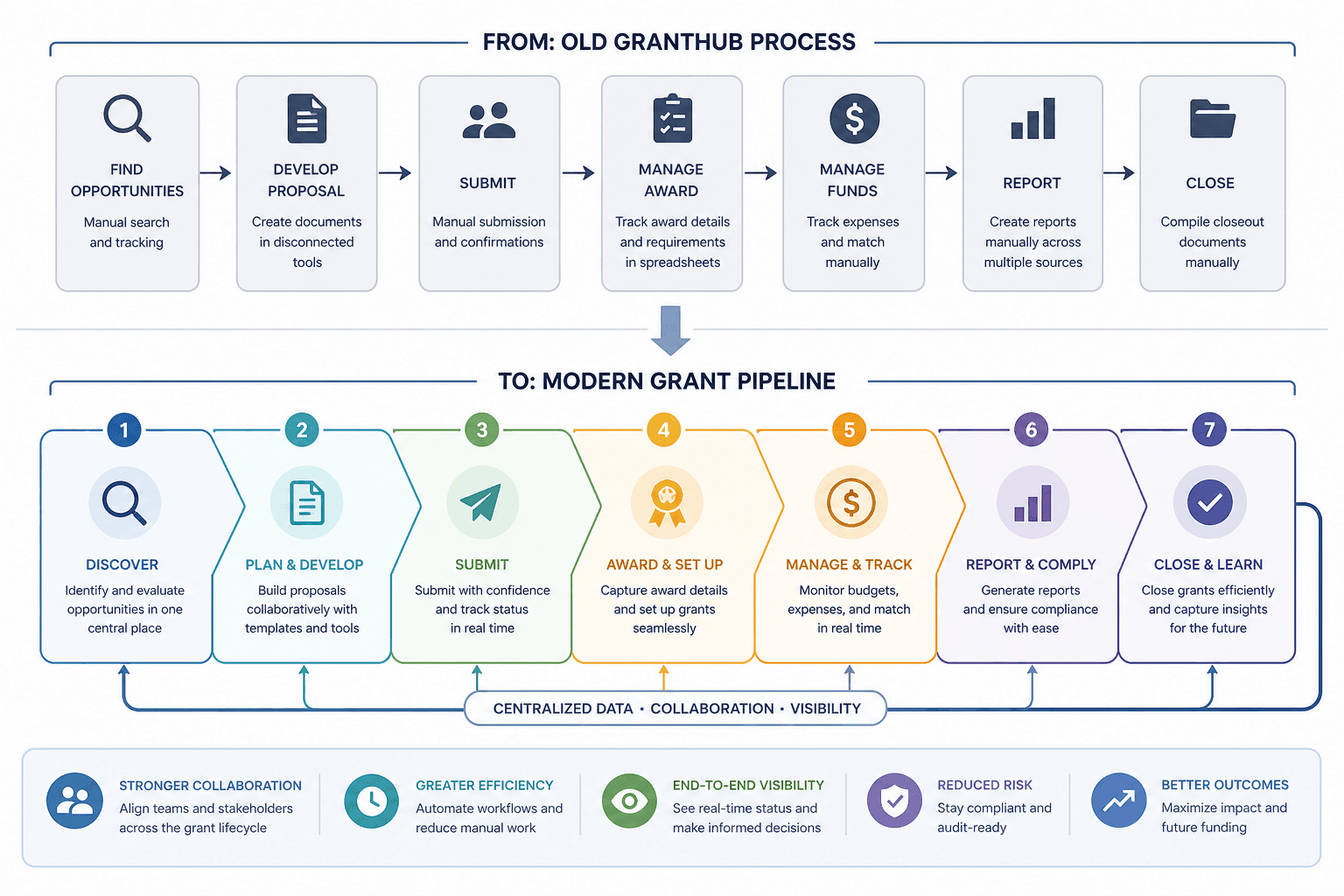
Last updated: July 2026
Moving away from GrantHub is a process rebuild as much as a software change. Your team needs clear stages, owners, deadlines, documents, reporting tasks, and leadership visibility.
Use this guide with the full GrantHub migration page after importing exported data.
Quick Answer: What Process Should Replace GrantHub?
| Process Area | GrantCue Workflow |
|---|---|
| Prospecting | Discover and save opportunities |
| Qualification | Review fit and eligibility |
| Drafting | Assign proposal owners and tasks |
| Submission | Track portal status and confirmation |
| Award | Track budget, compliance, and reports |
| Decline | Archive reason and next steps |
| Renewal | Set future deadlines and reminders |
Step 1: Define Pipeline Stages
Start simple:
- Researching.
- Qualified.
- Drafting.
- Review.
- Submitted.
- Awarded.
- Declined.
- Reporting.
Do not overbuild stages during migration. Add complexity only when the team needs it.
Step 2: Assign Owners

Every active grant needs:
- Program owner.
- Writing owner.
- Budget owner.
- Approval owner.
- Submission owner.
- Reporting owner.
One person may hold multiple roles, but the roles should be explicit.
Step 3: Rebuild Deadline Management
Track more than the application due date:
- LOI date.
- Internal draft date.
- Budget review date.
- Board approval date.
- Submission date.
- Award notification date.
- Report dates.
- Renewal date.
Deadline management is the part of the process where spreadsheet systems most often fail.
Step 4: Preserve Funder Notes
Do not lose relationship history. Import or recreate:
- Contact names.
- Past applications.
- Award decisions.
- Feedback.
- Reporting preferences.
- Renewal timing.
These notes help future writers avoid repeating old mistakes.
Step 5: Create Leadership Reporting

Leadership usually needs:
- Active pipeline count.
- Upcoming deadlines.
- Amount requested.
- Amount awarded.
- Win/loss status.
- Bottlenecks.
- Reports due.
Set a recurring monthly review so the grant pipeline stays current.
Common Mistakes
Mistake 1: Importing Without Ownership
A grant without an owner will drift.
Mistake 2: Treating Awarded Grants as Finished
Awarded grants often create reporting, spending, and compliance work.
Mistake 3: Keeping Every Old Status
Too many statuses make the new process confusing. Start with a clean pipeline.
The Process Goal: Fewer Surprises
The best replacement process is not the most complicated one. It is the process that prevents missed deadlines, unclear ownership, lost documents, and surprise reports. Former GrantHub teams should use the transition to simplify how grant work moves from idea to award to closeout.
The process should answer five questions for every grant:
- What is the opportunity?
- Why are we pursuing it?
- Who owns the next action?
- What date matters next?
- What happens if we win?
If the system answers those questions, it is already more useful than a cluttered tracker.
Recommended Pipeline Stages
Use a simple stage set:
| Stage | Meaning |
|---|---|
| Watch | Possible future opportunity |
| Qualifying | Reviewing eligibility and fit |
| Planning | Deciding project, budget, owner, and timeline |
| Drafting | Narrative and budget in progress |
| Internal Review | Program, finance, and leadership review |
| Submitted | Application sent, awaiting decision |
| Awarded | Funded and ready for setup |
| Reporting | Active award with reports due |
| Closed | Final report submitted and archived |
| Declined | Not funded or not pursued |
Avoid stages that only one staff member understands. A good stage name should explain itself.
Weekly Grant Meeting Agenda
Former GrantHub teams can rebuild discipline with a 30-minute weekly meeting:
- Deadlines in the next 30 days.
- Reports due in the next 60 days.
- Applications needing finance review.
- Applications needing program input.
- Funder questions or updates.
- Blocked tasks.
- New opportunities to qualify.
The meeting should update the system, not create a separate set of notes. If decisions happen in the meeting, record them in the grant record.
Ownership Rules
Every grant should have:
- A grant owner.
- A program owner.
- A finance owner if budget or reporting is involved.
- A final approver.
The grant owner coordinates the work, but that person should not silently own every decision. Program staff own program design. Finance owns budget accuracy. Leadership owns strategic fit and final commitments.
Post-Award Handoff
The post-award handoff is where many grant processes break. When a grant is awarded:
- Save the award letter.
- Confirm award amount and grant period.
- Compare award budget to requested budget.
- Record restrictions.
- Add report dates.
- Assign finance and program owners.
- Attach final proposal and budget.
- Schedule kickoff meeting.
Do this within the first week of award. The proposal should become the management plan.
Process Metrics to Track
Track a few metrics to improve the grant process:
| Metric | Why It Helps |
|---|---|
| Applications submitted | Shows volume |
| Applications declined before writing | Shows qualification discipline |
| Win rate | Shows funding effectiveness |
| Average days from discovery to submit | Shows planning time |
| Reports submitted on time | Shows post-award health |
| Renewal opportunities captured | Shows funder relationship discipline |
Do not overload the team with vanity metrics. Track what improves decisions.
First 60 Days After Replacing GrantHub
| Timeframe | Process Focus |
|---|---|
| Week 1 | Active deadlines and awarded reports |
| Week 2 | Pipeline stages and owners |
| Week 3 | Documents and funder notes |
| Week 4 | Leadership dashboard |
| Month 2 | Proposal library and renewal calendar |
By the end of month two, the team should have a repeatable grant rhythm.
Standard Operating Procedure Template
Document the replacement process in one page:
| Process Area | Rule |
|---|---|
| New opportunity | Add to Watch or Qualifying with source URL |
| Apply decision | Program and leadership approve before drafting |
| Owner | Every active grant has one grant owner |
| Budget | Finance reviews before internal review stage |
| Submission | Save confirmation and final files |
| Award | Create award setup task within one week |
| Reports | Add every report date to the calendar |
| Closeout | Archive final report and lessons learned |
This one-page SOP is more useful than a long manual nobody reads.
Escalation Rules
Define when staff should escalate:
- Deadline is less than 10 business days away and no owner is assigned.
- Budget is not approved three business days before submission.
- Required attachment is missing.
- Award terms differ from proposal assumptions.
- Report data is incomplete two weeks before due date.
- Funder asks for a budget change.
- A grant is at risk of late submission.
Escalation rules prevent quiet failure. They tell staff when to raise a hand.
Process Review Questions
At the end of each month, ask:
- Which deadlines were met?
- Which tasks slipped?
- Which applications were declined before writing?
- Which awarded grants need attention?
- Which funder relationships need follow-up?
- Which records are missing documents?
- Which process step caused the most friction?
Use the answers to improve the workflow. Process management is not a one-time migration step.
Example Monthly Leadership Report
Leadership does not need every note. A concise report can include:
- 8 active opportunities.
- $425,000 total pending requests.
- 3 applications due in the next 30 days.
- 2 reports due in the next 60 days.
- 1 award awaiting contract.
- 4 opportunities declined before writing because of low fit.
- 2 renewal conversations scheduled.
This gives leaders the health of the pipeline without asking staff to build a new spreadsheet.
Connect the process to migration
If your team is still moving records out of GrantHub, start with the GrantHub migration guide. Once the data is clean, rebuild the workflow with a grant pipeline dashboard, a reliable grant calendar, and grant management software for nonprofits that can carry applications through reporting and closeout.
RACI Model for Grant Process Ownership
Use a simple RACI model:
| Task | Responsible | Accountable | Consulted | Informed |
|---|---|---|---|---|
| Qualify grant | Grant owner | Executive director | Program, finance | Leadership |
| Draft narrative | Grant writer | Grant owner | Program | Leadership |
| Draft budget | Finance | Finance lead | Program, grant writer | Executive director |
| Final review | Grant owner | Executive director | Program, finance | Board if required |
| Submit | Authorized representative | Executive director | Grant owner | Team |
| Award setup | Grant owner | Finance lead | Program | Leadership |
| Report | Program and finance | Grant owner | Executive director | Funder |
This prevents the common post-GrantHub problem where everyone can see a grant but nobody knows who owns the next action.
Cadence by Grant Stage
| Stage | Review Cadence |
|---|---|
| Watch | Monthly |
| Qualifying | Weekly until decision |
| Drafting | Two or more times per week near deadline |
| Internal Review | Daily during final week if needed |
| Submitted | Monthly until decision |
| Awarded | Kickoff within one week |
| Reporting | Monthly or quarterly based on requirements |
| Closeout | 30 to 60 days before end date |
Cadence keeps the process alive. A pipeline that is not reviewed becomes a stale list.
Process Adoption Checklist
After the process is defined, confirm adoption:
- New opportunities are entered within two business days.
- Every active grant has an owner.
- Deadlines are reviewed weekly.
- Reports are reviewed monthly.
- Submitted proposals are archived.
- Award letters trigger setup tasks.
- Finance can see awarded grants.
- Leadership receives one standard pipeline report.
If these actions are not happening, simplify the process. The system may have too many stages, unclear roles, or reports that do not match how people work.
Example Grant Process Policy
"All grant opportunities with potential organizational fit must be entered into GrantCue before drafting begins. The grant owner is responsible for maintaining status, deadline, source URL, and next action. Finance must review all proposal budgets before submission. Awarded grants must be converted to post-award tracking within five business days of award notice. Final proposals, budgets, award letters, and reports must be attached to the grant record."
This policy is short enough to use and specific enough to prevent confusion.
Process Completeness Checklist
Before calling the process complete, confirm:
- Pipeline stages are documented.
- Ownership rules are documented.
- Budget review is required before submission.
- Award setup has a checklist.
- Report dates are entered as deadlines.
- Closeout is a stage, not an afterthought.
- The monthly leadership report has one owner.
This gives the team a process it can repeat after the urgency of migration fades.
Process Maintenance Reminder
Review the process quarterly. Remove stages no one uses, update owner rules when staff roles change, and check whether reports are still useful to leadership. A grant process should be stable, but it should not become stale.
When the process is maintained, staff are less likely to create informal side systems that slowly replace the official source of truth.
The process should be easy enough that people actually use it during deadline pressure.
If it only works during quiet weeks, it is too fragile for grant work.
FAQ
Should we recreate our old GrantHub workflow exactly?
Usually no. Preserve useful data, but simplify the process where possible.
What is the first process to rebuild?
Deadlines and ownership. Those are the highest-risk areas during migration.
Next Step
Once your data is out of GrantHub, put this workflow to work: set your stages, assign an owner to every active grant, and load each deadline into one place. If you are still mid-move, the complete GrantHub migration plan covers the import first, then connect the clean records to solid grant pipeline management practices so the team works from one source of truth.
Sources and Further Reading
TechSoup — discounted and donated software for nonprofits, plus vendor-neutral guidance on choosing tools.
2 CFR Part 200 (Uniform Guidance) — the federal regulation governing award management, allowable costs, and reporting.