To the Grant Writers Working Through the Holidays (And Everyone Who Kept Going This Year)
The week between Christmas and New Year's is quiet for most offices, but not for grant writers. This post is a genuine thank you to the nonprofit professionals still chasing deadlines, clearing backlogs, and preparing for Q1. We reflect on the invisible work of grant writing, acknowledge the challenges of 2025, and share practical thoughts on pipeline planning, capacity, timing, and self-care heading into the new year.

In this article (13)
- The Work Nobody Sees
- The Year You Just Survived (Because Let's Be Honest, 2025 Was A Lot)
- A Genuine Thank You (No Corporate Fluff, We Promise)
- Okay, Deep Breath. Let's Talk About 2026.
- First: Take Stock of Where You Are
- Second: Get Honest About Capacity
- Third: Think About Timing
- Fourth: Build in Some Buffer
- Fifth: Don't Go It Alone
- Sixth: Celebrate the Wins (Seriously)
- A Quick Word About Tools (Since That's Kind of Our Thing)
- Here's to 2026
- Sources and Further Reading
There's a particular kind of quiet in a nonprofit office the week between Christmas and New Year's. Half the team is out. The email pace slows to a trickle. The coffee maker gets a rest.
But somewhere — maybe at a kitchen table, maybe in a home office with holiday lights blinking in the periphery, maybe at that one desk in the corner of an otherwise empty building — someone is still working on a grant.
Maybe that's you right now.
Maybe you're staring at a December 31st deadline that seemed so far away back in October. Maybe you're getting a head start on a January submission because you know how fast the new year fills up. Maybe you're just trying to clear out the backlog of funder reports that have been haunting your to-do list for weeks.
Whatever brought you here, we see you. And this one's for you.
The Work Nobody Sees
Here's something we've been thinking about lately: grant writing might be one of the most invisible jobs in the nonprofit world.
When a program launches, the program staff get celebrated. When a fundraising gala hits its goal, the development director gets the applause. When the executive director announces a big new initiative at the board meeting, everyone's excited.
But the grant that made it all possible? The one that took three months to research, two weeks to write, and seventeen revisions to get right? The one that required hunting down budget numbers from four different departments and translating a 47-page federal NOFO into something that actually made sense?
That work happens in the background. It happens in early mornings and late nights. It happens in the cracks between meetings and the margins of already-full days.
And most of the time, nobody outside your organization — and sometimes nobody inside it either — really understands what went into it.
We get it. We've talked to enough grant managers and development coordinators to know that this work is relentless. There's always another deadline. Always another opportunity that looks promising. Always another report due.
The wins feel good, but they're fleeting. You celebrate for a day, maybe two, and then you're back to the next application.
The rejections sting, but you don't get to dwell on them. There's no time.
And through all of it, you keep going. Because you know what's on the other side of that funded grant: real programs, real services, real impact for real people.
The Year You Just Survived (Because Let's Be Honest, 2025 Was A Lot)
We're not going to pretend 2025 was easy. For a lot of nonprofits, it wasn't.
Funding landscapes shifted. Some federal programs saw cuts. Some foundations changed their priorities. Some of you watched opportunities you'd been counting on disappear entirely.
Meanwhile, the needs in your community probably didn't shrink. If anything, they grew. More people needed help. More programs needed funding. More pressure landed on fewer shoulders.
And through all of that, you kept showing up.
You kept scanning Grants.gov for new opportunities. You kept building relationships with program officers. You kept making the case for your organization's work, over and over again, in application after application.
That takes something. It takes persistence. It takes belief in what you're doing. It takes a kind of stubborn optimism that refuses to quit even when the odds feel stacked against you.
So before we talk about 2026 — before we get into planning and pipelines and all the practical stuff — we just want to pause and say: you made it through this year. That's not nothing.
Whatever you got funded, whatever you didn't, whatever's still pending — you showed up and you did the work. And that matters.
A Genuine Thank You (No Corporate Fluff, We Promise)
We started GrantCue because we believed there had to be a better way to manage this whole process. Spreadsheets are fine until they're not. Sticky notes work until they fall off the wall. Email chains get buried. Deadlines get missed. Things slip through the cracks.
We wanted to build something that actually helped.
But here's what we've realized along the way: the tool is only part of the equation. The real magic — the thing that actually gets grants written and submitted and funded — is the people doing the work.
That's you.
You're the one who reads a 50-page funding announcement and figures out whether it's worth pursuing. You're the one who somehow makes your organization's work fit into whatever framework the funder is asking for. You're the one who chases down letters of support and budget justifications and organizational charts.
You're the one who hits submit at 11:47 PM and then lies awake wondering if you should have phrased that one sentence differently.
We can build software. We can make the tracking easier. We can help you stay organized.
But we can't do what you do. Nobody can. It takes a particular combination of writing skill, strategic thinking, attention to detail, relationship management, and sheer determination that's honestly kind of remarkable when you step back and look at it.
So from our small team to yours: thank you.
Thank you for caring enough to keep doing this work. Thank you for fighting for funding that will help your community. Thank you for being the person who makes things happen behind the scenes, even when nobody notices.
We notice. And we're grateful you're out there.
Okay, Deep Breath. Let's Talk About 2026.
The new year is almost here. Which means a fresh batch of deadlines, a new set of opportunities, and — let's be honest — probably the same overstuffed calendar you had this year.
But there's something kind of nice about January, isn't there? A clean slate. A chance to do things a little differently. Maybe not a complete overhaul, but some small adjustments that might make the year a little more manageable.
Here are some thoughts on heading into 2026. Not a prescriptive checklist — you know your situation better than we do — but some ideas that might be worth considering.
First: Take Stock of Where You Are
Before you start chasing new opportunities, it's worth pausing to look at what's already on your plate.
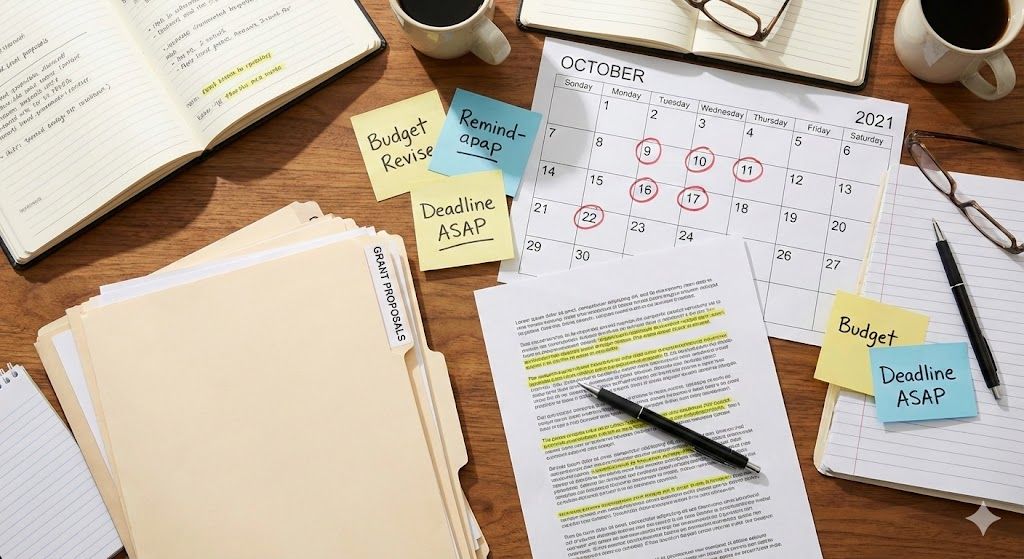
What grants are currently in progress? What's in the research phase? What's actively being written? What's been submitted and is waiting for a decision?
What deadlines are coming up in Q1? Are there any that snuck up on you? Any that you forgot about entirely?
What fell off your radar this year? Were there opportunities you meant to pursue but never got around to? Are they still relevant?
What's the status of your current awards? Any reports due? Any compliance requirements you've been putting off?
This doesn't have to be a formal audit. Even just spending an hour reviewing your pipeline — whatever form that takes, whether it's a spreadsheet or a project management tool or a stack of folders — can help you start the year with a clearer picture.
It's easy to get caught in reactive mode, just responding to whatever's most urgent at any given moment. Taking a little time now to see the full landscape can help you be more intentional about where you focus your energy.
Paid research tools belong in the same review, and a checklist for deciding whether to renew Candid starts with who signed in and what the account produced.
Second: Get Honest About Capacity
This one's hard. But it's important.
How many grants can you realistically pursue this year? Not in an ideal world where you have infinite time and energy and support. In the actual world you're living in, with the team you have and the other responsibilities on your plate.
It's tempting to say yes to everything that looks promising. That NOFO seems like a good fit. That foundation's priorities align with your work. That new federal program just opened up.
But every grant you pursue takes time. Research time. Writing time. Coordination time. And if you spread yourself too thin, the quality of every application suffers.
There's no magic number. It depends on the size and complexity of the grants, the strength of your team, and how much other work is competing for your attention.
But it's worth being honest with yourself. Sometimes pursuing fewer opportunities — and pursuing them really well — leads to better outcomes than trying to do everything.
Third: Think About Timing
Not all deadlines are created equal. Some are firm. Some have rolling submissions. Some have multiple cycles throughout the year.
As you look at 2026, it's worth mapping out when things are due and how that aligns with your capacity.
Q1 tends to be heavy for federal grants. A lot of agencies release new NOFOs in January and February, with deadlines in March and April. If you're pursuing federal funding, this is often crunch time.
Foundation deadlines are all over the map. Some have spring cycles, some have fall cycles, some accept applications year-round. If you're juggling federal and foundation grants, pay attention to how the timelines overlap.
And don't forget about reporting. Award reports often come due at predictable times — end of fiscal year, end of grant period, specific anniversaries. Building those into your calendar now can prevent the last-minute scramble later.
The goal isn't to create a rigid schedule that you'll inevitably break. It's just to have a rough sense of what's coming so you're not constantly surprised.
Fourth: Build in Some Buffer
Deadlines are stressful enough without making them worse than they need to be.
If you have any control over your timeline — and we know that's a big "if" — try to build in some breathing room. Aim to finish drafts a few days before they're due. Give your reviewers actual time to review. Leave margin for the unexpected.
This is easier said than done. We know that. The nature of this work is that everything is urgent and nothing ever feels like it's ahead of schedule.
But even small buffers help. Finishing a day early instead of an hour early can be the difference between catching a mistake and missing it entirely. Having time to step away and come back with fresh eyes can improve the quality of your writing.
And honestly? It's just better for your mental health. The constant feeling of being right up against the wire is exhausting. Any space you can create, even a little, is worth it.
Fifth: Don't Go It Alone
Grant work can feel isolating. Especially if you're the only person at your organization who really understands what's involved. Especially if you're working remotely. Especially during the slow weeks when everyone else is checked out and you're still grinding.
But you don't have to do this completely by yourself.
If you have colleagues, lean on them. Not just for the work itself — though that helps — but for the moral support. Sometimes just talking through a tricky application with someone else can unstick your thinking.
If you're a solo grant writer, look for community elsewhere. There are online groups, professional associations, informal networks of people doing similar work. Finding your people — even if it's just a few folks you swap war stories with occasionally — can make the work feel less lonely.
And if you're in a position to mentor someone newer to this field, consider it. Not just because it's generous, but because teaching someone else often clarifies your own thinking. Plus, the field needs more people who know how to do this well.
Sixth: Celebrate the Wins (Seriously)
This is the one everyone skips. Don't skip it.
When you get a grant funded, take a moment to actually feel good about it. Tell your team. Tell your board. Tell whoever will listen.
Not in a bragging way. In a "we worked really hard on this and it paid off" way.
Grant wins are a big deal. They represent months of effort. They're going to fund real work that matters. They deserve to be acknowledged.
And when you don't win — because that happens too, and it happens to everyone — try to learn what you can and then let it go. Some rejections have useful feedback. Some are just the luck of the draw. Either way, dwelling on them doesn't help.
The rhythm of this work is relentless. If you don't intentionally pause to recognize the victories, they'll blur into the background and all you'll remember is the stress. That's not sustainable. Take the wins when they come.
A Quick Word About Tools (Since That's Kind of Our Thing)
We're obviously biased here, but we'll say it anyway: if you're still tracking grants in spreadsheets and it's working for you, great. Keep doing that.
But if it's not working — if things are slipping through the cracks, if you're losing track of deadlines, if collaboration is a mess, if you spend more time managing the spreadsheet than actually writing grants — there are better options.
We built GrantCue to be one of those options. It's designed specifically for this work: finding federal opportunities, tracking them through your pipeline, managing tasks and deadlines, keeping your team on the same page.
We're not going to pretend it solves everything. It's a tool, not a miracle. You still have to do the work.
But if the administrative overhead of grant management is eating into your actual grant writing time, it might be worth a look. That's all we'll say about it.
Here's to 2026

We don't know what the new year will bring. Nobody does. Funding landscapes will shift. Priorities will change. There will be surprises, good and bad.
But we do know this: there will be people like you, showing up to do this work. Scanning for opportunities. Writing proposals. Making the case for your organization's mission. Fighting for the funding that makes everything else possible.
That's not going to change. And as long as you're out there doing it, we'll be here trying to make it a little easier.
So take a breath. Enjoy the rest of the holidays if you can. Eat some cookies. Spend time with people you care about. Let yourself recharge, even just a little.
And when January hits and the deadlines start rolling in again, know that you've got this. You've done it before. You'll do it again.
Here's to a strong 2026.
— The GrantCue Team
Sources and Further Reading
Candid Learning — free courses and reference material on proposal writing and funder research, from the organization behind Foundation Directory.
Grants.gov — the central portal for finding and applying to federal grant opportunities.